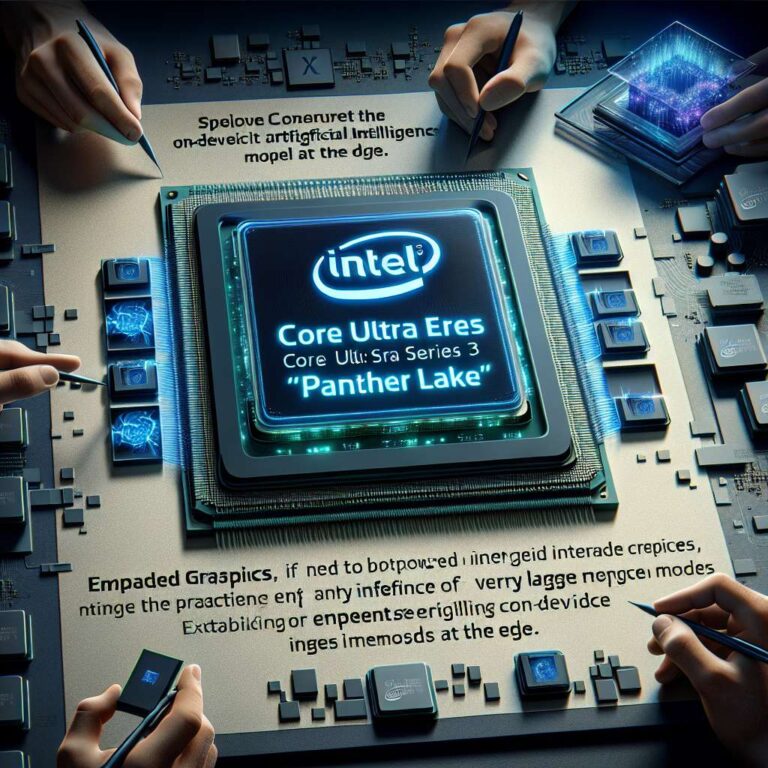
Intel’s CES 2026 launch event centered on the formal debut of its Core Ultra Series 3 processors, codenamed Panther Lake, which the company is pitching as the backbone of a new generation of Artificial Intelligence focused laptops, gaming devices and edge systems. The chips are manufactured on an 18A process, which Intel described as 18 angstroms, or just under 2nm, and are designed for high-end mobile form factors while also being newly certified for embedded and industrial deployments such as robotics and smart cities. The launch comes at a critical moment for Intel as rivals like TSMC, Qualcomm, AMD and NVIDIA have taken a leadership role in chip fabrication and Artificial Intelligence hardware, even as NVIDIA and the US government have acquired ownership stakes in Intel that helped nearly double its stock price by the end of the year but still left it more than 20 percent below its 2021 level.
Senior vice president Jim Johnson led the presentation, outlining a lineup that includes Core Ultra 7 and 9, as well as Core X7 and X9 variants, which ship with 12 Xe graphics cores instead of the usual four. Intel said almost all of the new processors offer 16 total cores and threads, and that all but two configurations deliver total NPU performance of 50 PTOPS, signaling a strong focus on on-device Artificial Intelligence workloads. Johnson stated that Series 3 offers up to 180 TOPS of total Artificial Intelligence performance, with 120 TOPS coming from the GPU alone, and claimed that the best Series 3 chip can handle a 70 billion parameter model locally, something he said none of Intel’s competitors can match today. The company framed this capability as increasingly important as limits on how quickly new data centers can be built push more Artificial Intelligence inference work to the edge.
Gaming and graphics also featured prominently, with Intel executive Dan Rogers promoting new Arc based integrated graphics and a forthcoming B390 component that he said will deliver discrete-like GPU performance in thin and light laptops, including support for multi-frame generation from day one. Intel showed a slide claiming its new integrated GPU can render Battlefield 6 on Overkill settings at 145 FPS using Super Resolution and 3X multiframe generation, while acknowledging that such techniques may have trade-offs like increased input lag. The company teased an “entire” gaming handheld platform built on Panther Lake with more details due later in the year, and brought on Electronic Arts to discuss how Artificial Intelligence tools can enhance game graphics. Intel also highlighted a partnership with Perplexity, with CEO Aravind Srinivas underscoring the importance of “localized compute” to cut Artificial Intelligence latency, and Johnson sought to reassure viewers that Intel has a clear plan to make Artificial Intelligence profitable. Pre-orders for select Core Ultra Series 3 products will begin tomorrow, as Intel looks to turn its new architecture into the start of a broader comeback.