
New Method Extracts Simple Rules from Complex Neural Networks

A novel approach unveils the underlying logic of neural networks, making complex predictions more understandable.

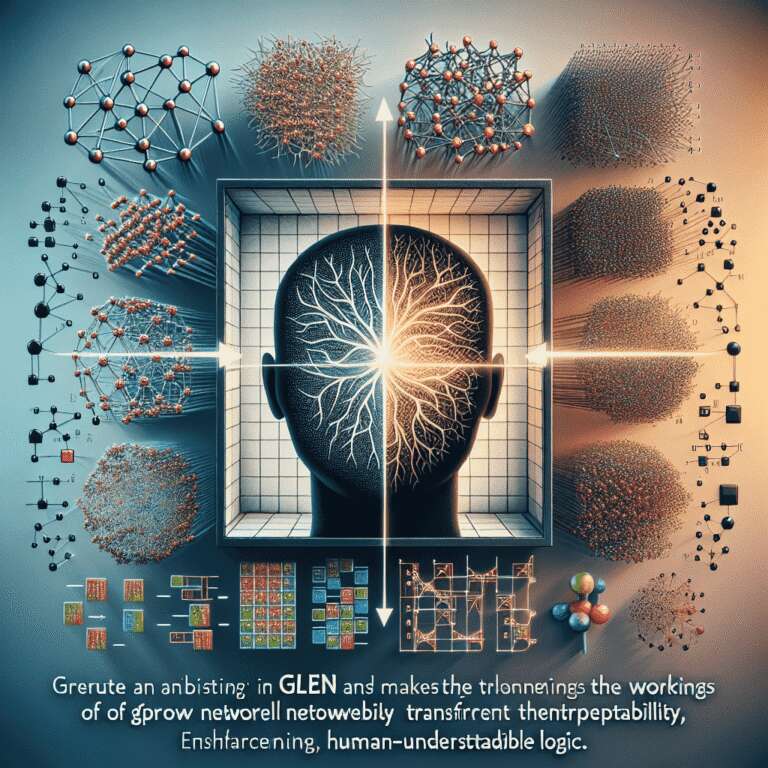
A groundbreaking study has introduced a method called GLEN that extracts simple, interpretable rules from complex Neural Networks, particularly Graph Neural Networks (GNNs). This method focuses on maintaining the predictive power of GNNs while significantly enhancing their transparency and interpretability.

The GLEN approach employs a two-stage process involving pruning and rule extraction to decode the sophisticated logic of GNNs, which are used extensively for tasks involving connected data, such as social networks and molecular structures. By leveraging this method, researchers achieved up to 95.7% fidelity to the original GNN predictions without losing performance, thus bridging the gap between high-performance and explanation in machine learning models.

One of the key advantages of this technique is that it offers human-readable logic rules that align with domain knowledge present in real-world datasets. This has profound implications for industries relying on deep learning models to provide explanations for their predictions, enhancing trust and utility in these systems.
77

Impact Score

Inside the UK’s artificial intelligence security institute

The UK’s artificial intelligence security institute has found that popular frontier models can be jailbroken at scale, exposing reliability gaps and security risks for governments and regulated industries that rely on trusted vendors.

Siemens debuts digital twin composer for industrial metaverse deployments

Siemens has introduced digital twin composer, a software tool that builds industrial metaverse environments at scale by merging comprehensive digital twins with real-time physical data, enabling faster virtual decision making. Early deployments with PepsiCo report higher throughput, shorter design cycles and reduced capital expenditure through physics-accurate simulations and artificial intelligence driven optimization.

Cadence builds chiplet partner ecosystem for physical artificial intelligence and data center designs

Cadence has introduced a Chiplet Spec-to-Packaged Parts ecosystem aimed at simplifying chiplet design for physical artificial intelligence, data center and high performance computing workloads, backed by a roster of intellectual property and foundry partners. The program centers on a physical artificial intelligence chiplet platform and framework that integrates prevalidated components to cut risk and speed commercial deployment.

Contact Us

Got questions? Use the form to contact us.

Contact Form

Clicking next sends a verification code to your email. After verifying, you can enter your message.