
Reducing privacy leaks in artificial intelligence: two approaches to contextual integrity

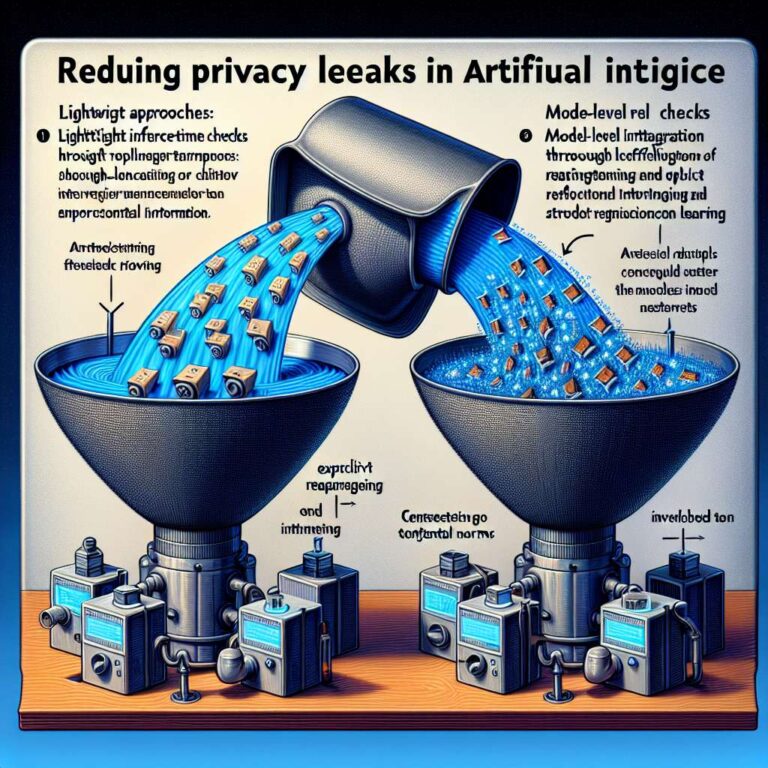
New research from Microsoft Research presents two methods to reduce privacy leaks in artificial intelligence using the principle of contextual integrity. One method applies lightweight, inference-time checks and the other builds contextual awareness into models through reasoning and reinforcement learning.

Microsoft Research published new work that explores how to strengthen privacy safeguards for artificial intelligence agents by applying the concept of contextual integrity. The research frames privacy leaks as failures of contextual norms and investigates practical ways to align model behavior with those norms. The post highlights two distinct approaches developed or analyzed by the researchers, situating the effort as part of ongoing work to make models more sensitive to when and how private information should be shared.

The first approach described in the research uses lightweight, inference-time checks. These checks operate at the moment a model generates a response and act as an additional layer that evaluates whether a potential output would violate contextual privacy expectations. Because they are applied at inference time and are characterized as lightweight, they are presented as a way to add privacy safeguards without rebuilding underlying model architectures or retraining large systems.

The second approach integrates contextual awareness directly into models through explicit reasoning and reinforcement learning. Instead of relying on post hoc checks, this method aims to teach models to internalize contextual integrity during training or through reward-driven learning so that their outputs reflect privacy-aware behavior by design. The research thus places two different strategies side by side: one that supplements existing models at inference and one that seeks to embed contextual norms within model reasoning and learning dynamics.
55

Impact Score

Google Vids opens free video generation to all Google users

Google has made Google Vids available to anyone with a Google account, adding free access to video generation with its latest models. The move expands Google’s end-to-end video workflow and increases pressure on rivals that charge for similar tools.

Court warns against chatbot legal advice in Heppner case

A federal court found that chats with a publicly available generative Artificial Intelligence tool were not protected by attorney-client privilege or the work-product doctrine. The ruling highlights litigation risks when executives or employees use chatbots for legal guidance without lawyer supervision.

Newsom orders California to weigh Artificial Intelligence harms in contract rules

Gov. Gavin Newsom has signed an executive order directing California agencies to account for potential Artificial Intelligence harms in state contracting while expanding approved use of generative tools across government. The move follows a dispute involving Anthropic and reflects a broader split between California and the Trump administration on Artificial Intelligence oversight.

Contact Us

Got questions? Use the form to contact us.

Contact Form

Clicking next sends a verification code to your email. After verifying, you can enter your message.