
Minisforum Strix Halo desktop with 80 Gbps USB4 v2 and Artificial Intelligence processor

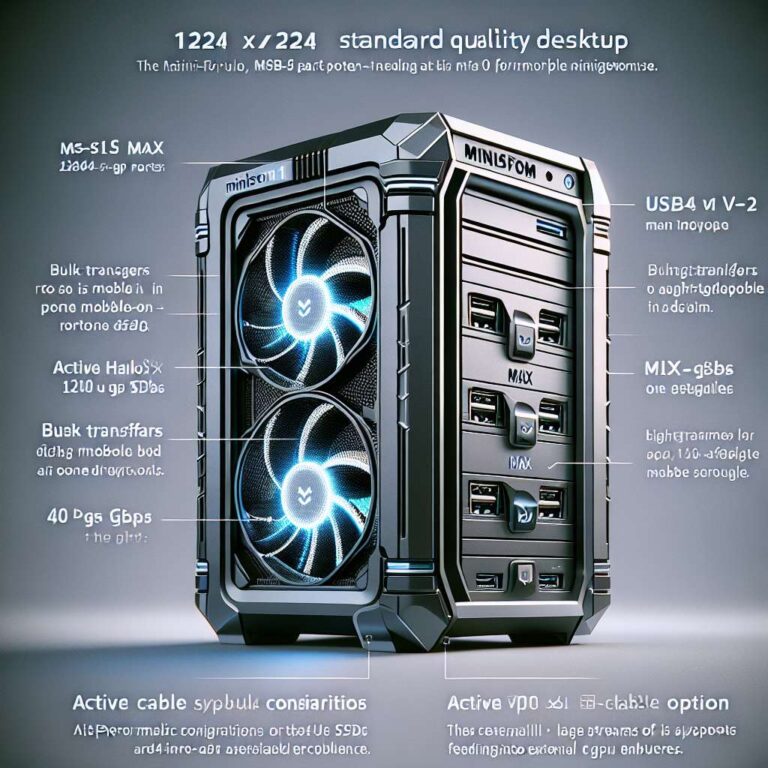
Minisforum has revealed the MS-S1 Max Artificial Intelligence desktop, a mini-tower using a mobile-on-desktop mainboard and an AMD Ryzen Artificial Intelligence Max+ 395 ´Strix Halo´ processor. The flyer highlights 80 Gbps USB4 v2 ports, a likely first for client desktops.

Minisforum has detailed the MS-S1 Max Artificial Intelligence desktop, a mini-tower that uses a mobile-on-desktop mainboard and an AMD Ryzen Artificial Intelligence Max+ 395 ´Strix Halo´ processor. The company positions the MS-S1 Max as a straightforward mobile-on-desktop implementation of the Strix Halo platform. The most notable item on the published flyer is the inclusion of USB4 v2 ports rated for 80 Gbps, a capability the article describes as probably the industry first in the client desktop segment.

The article outlines how USB4 v2.0 evolved from the original USB4 specification drafted in 2019 and standardized for the 80 Gbps tier in 2022. USB4 v2.0 introduces a PAM3 coding scheme over the existing pin count rather than simply mapping PCIe Gen 4 physical layers to USB. The standard is designed for backward compatibility with passive cables rated for 40 Gbps while enabling a fixed 80 Gbps per-direction bandwidth when supported. In addition to passive-cable compatibility, USB4 v2.0 specifies an active cable design that can distribute bandwidth asymmetrically between transmit and receive lanes.

The article notes that the active-cable option can enable asymmetric configurations such as 120 Gbps in one direction and 40 Gbps in the other, which could be useful for scenarios like large data transfers to or from portable solid state drives or external GPU enclosures. The piece also draws a direct parallel to Thunderbolt 5, saying the asymmetric bandwidth concept mirrors Thunderbolt 5´s Bandwidth Boost feature that Intel introduced. Beyond the USB4 v2 details, the MS-S1 Max is presented as a typical Strix Halo mobile-on-desktop build with the headline takeaway being early adoption of high-bandwidth USB4 v2 ports in a client desktop product.
67

Impact Score

Artificial Intelligence agents face memory limits in wealth management

Citi is pushing deeper into Artificial Intelligence for wealth management with a new digital advisor, but industry executives say agent memory remains a major constraint. Better short-term and long-term recall could eventually help advisors serve more clients and maintain more continuous relationships.

OpenClaw pushes autonomous Artificial Intelligence agents into enterprises

OpenClaw’s rapid growth is accelerating interest in persistent, self-hosted autonomous agents that run continuously instead of waiting for prompts. NVIDIA is positioning NemoClaw as a more secure reference implementation for organizations that want local control, auditability and hardened deployment defaults.

Indiana launches Artificial Intelligence business portal

Indiana is rolling out IN AI, a statewide portal meant to help employers adopt Artificial Intelligence with practical guidance, workshops and peer support. State leaders and business groups are positioning the effort as a way to raise productivity, wages and job growth while keeping workers at the center.

Goodfire launches model debugging tool for large language models

Goodfire has introduced Silico, a mechanistic interpretability platform designed to let developers inspect and adjust model behavior during development. The company is positioning it as a way to give smaller teams deeper control over open-source models and more trustworthy outputs.

Contact Us

Got questions? Use the form to contact us.

Contact Form

Clicking next sends a verification code to your email. After verifying, you can enter your message.