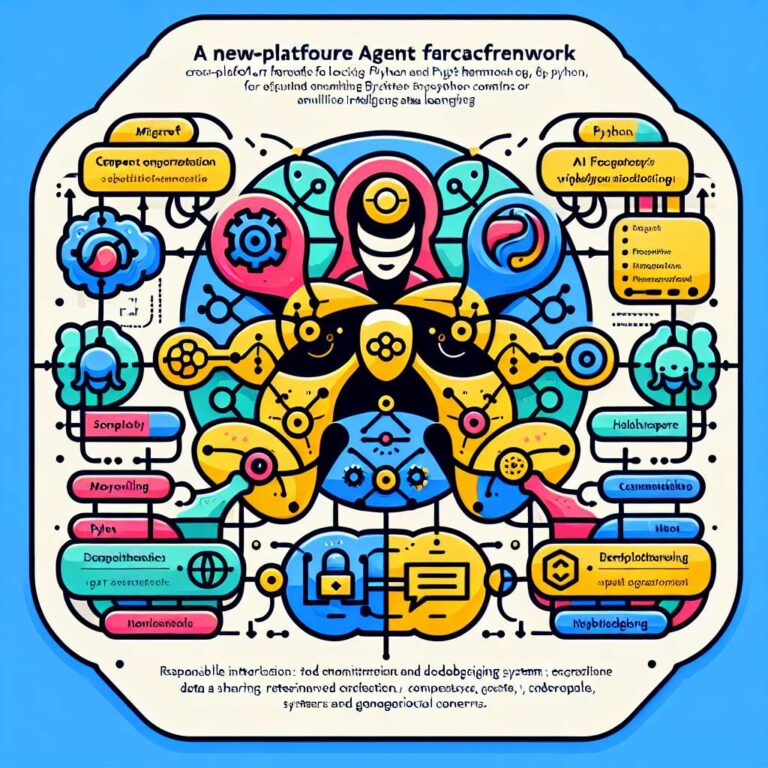
Microsoft agent framework is a multi-language platform for building, orchestrating, and deploying artificial intelligence agents and multi-agent workflows across .NET and Python. It supports use cases ranging from simple chat-style agents to complex graph-based orchestrations, and offers language parity between Python and C#/.NET through consistent application programming interfaces. The framework is released under the MIT license and is positioned as a general software development kit for agentic artificial intelligence scenarios.
The framework includes graph-based workflow orchestration that connects agents and deterministic functions using data flows, with streaming, checkpointing, human-in-the-loop, and time-travel capabilities. Developers can use a dedicated DevUI to interactively develop, test, and debug agents and workflows, and can explore experimental AF Labs packages focused on benchmarking, reinforcement learning, and research-oriented features. Built-in observability is provided through OpenTelemetry integration for distributed tracing, monitoring, and debugging, with specific guidance for Python observability and .NET telemetry. A flexible middleware system enables request and response processing, exception handling, and custom pipeline composition, and the framework supports multiple large language model providers with examples for both Python and .NET.
Getting started guides and tutorials cover basic agent creation, workflow integration, tooling, and migration from other ecosystems such as Semantic Kernel and AutoGen. Python installation is handled via a single pre-release package that brings in all sub-packages, while .NET developers can add Microsoft.Agents.AI and related OpenAI integrations through standard package commands. Example code demonstrates how to create simple agents, such as a “HaikuBot” that uses OpenAI Responses or Azure OpenAI Responses with either direct application programming interface keys or Azure CLI based token authentication. Additional samples illustrate agent provider variations and advanced multi-agent workflow patterns, and contributor resources include design documents, architectural decision records, and development guides. The project notes that applications interacting with third-party servers or agents are used at the developer’s own risk and stresses the need to understand data sharing, retention, and geographic and compliance implications.