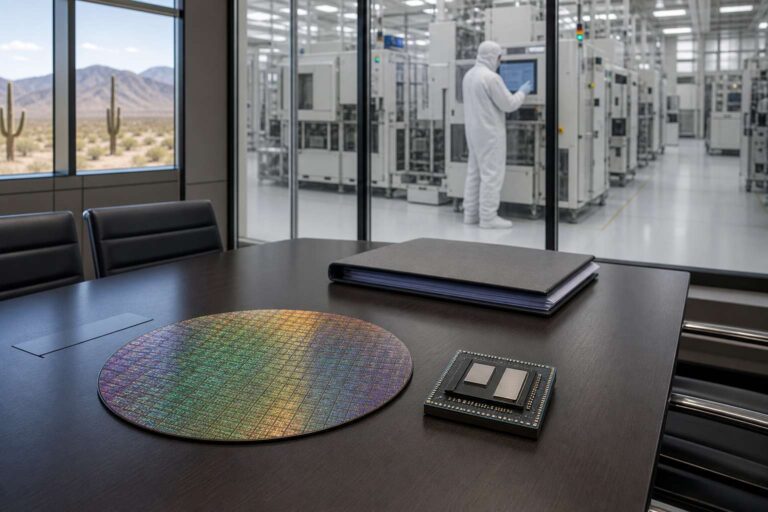
Intel spent three years promising investors its contract-manufacturing arm would eventually win outside customers. Google has reportedly committed to manufacturing more than three million of its custom Artificial Intelligence chips at Intel, and Nvidia is said to be testing Intel’s most advanced process for a future graphics chip. The companies have confirmed none of it, and the volumes that matter arrive in 2028. INTC jumped 6.5% on Friday anyway, closing at $124.57, roughly a third above the average price target on Wall Street.
According to reporting from The Information, later picked up by Reuters, Google has decided to have Intel produce more than three million tensor processing units, the in-house chips that run its Artificial Intelligence services, starting in 2028. That order is big enough to matter on its own: it is roughly half of Google’s expected TPU output for 2027 and 2028 on Morgan Stanley’s estimates, and Google reportedly made the call only after months of testing Intel’s packaging. Nvidia’s role is earlier-stage and, for now, more telling than material. It is evaluating Intel’s 18A process and EMIB packaging to build a GPU that fuses four graphics dies into one package, a design penciled in for around 2028.
The reports would address Intel Foundry’s central problem: trust from major external customers. Google and Nvidia matter because they are the customers everyone else watches. If the two companies most synonymous with Artificial Intelligence compute are willing to move silicon away from TSMC and toward Intel, smaller buyers read that as proof the 18A process works and that a second leading-edge foundry now exists outside Taiwan. Still, Intel, Google, and Nvidia have all declined to confirm the reports, and Reuters said it could not independently verify them.
Intel’s first quarter gave the move something to stand on. Revenue was $13.6 billion, about $1.4 billion above the midpoint of its own guidance, and management said Artificial Intelligence-related products made up roughly 60% of revenue and grew 40% from a year earlier. Non-GAAP gross margin landed at 41%. For the current quarter, Intel guided to $13.8-$14.8 billion. Intel Foundry had $5.4B revenue and a $2.4B operating loss, narrower than the prior quarter, but a long way from breakeven.
At Friday’s $124.57 close, INTC sat near the top of a 52-week range that runs from $18.96 to $132.75, and well above where most analysts say it belongs. TECHi’s INTC quote page shows a consensus 12-month target of $93.12, implying about 26% downside, with 48 analysts collectively rating it a Hold. The stock trades near 147 times forward earnings while its trailing net margin is still negative. The next hard checkpoint is July 22, when Intel reports again.