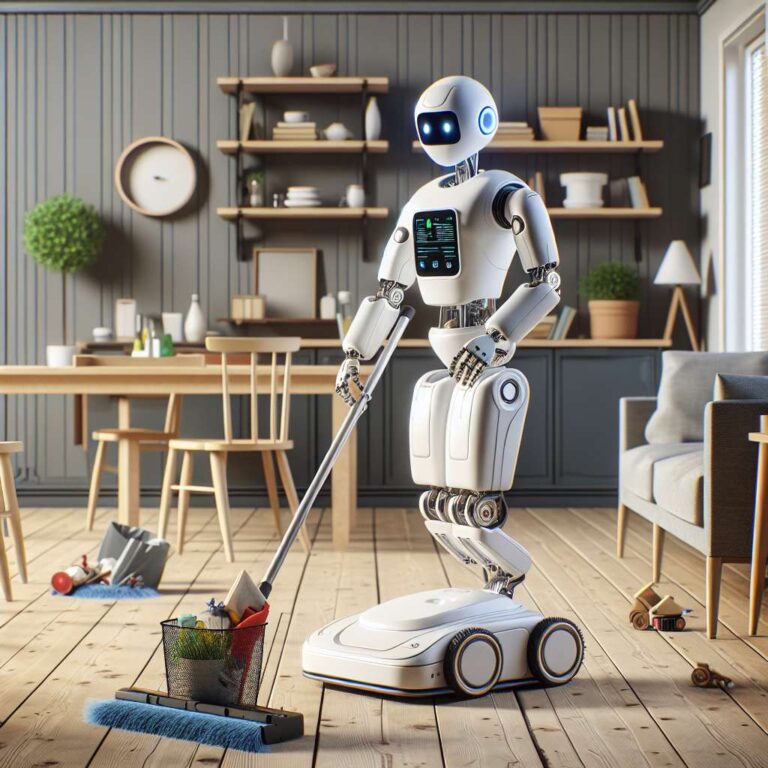
Figure says its Helix 02 model has moved beyond kitchen tasks and can now autonomously tidy a living room. Using the same general-purpose neural architecture, the humanoid reportedly carries out complex household tasks on its own while navigating tight gaps in furniture. The development is presented as a meaningful sign that scalable humanoid intelligence is getting closer to practical home use.
Other research and product updates point to a broader push toward more capable domestic and assistive robots. Scientists at the Technical University of Munich built a robot that uses 3D vision to locate misplaced household objects by creating a centimeter-accurate spatial map and estimating the most likely locations of missing items. The system finds objects 30% more efficiently than a random room search, and future versions are expected to search inside drawers and cupboards. Booster Robotics also introduced the K1 humanoid for children and education, with real-time walking, balancing, and interaction supported by depth cameras and motion sensors.
Security and safety also stood out this week. Engineer Sammy Azdoufal discovered a flaw while modifying a DJI Romo vacuum, unintentionally exposing a network of 7,000 DJI Romo vacuums to potential remote access. DJI is now paying Azdoufal $30k for the discovery, and has reportedly already patched the flaw. In Macau, a Unitree G1 humanoid reportedly became the first robot to be “arrested” by police after startling a 70-year-old woman in public, adding to concerns about robot behavior and safety in shared spaces.
Several robotics efforts focused on specialized mobility and environmental uses. Engineers at RMIT University built a dolphin-shaped robot designed to vacuum oil spills from water, using filtration that traps oil at more than 95% purity. The current prototype runs for 15 minutes, with future autonomous versions envisioned to empty, recharge, and redeploy independently. Chinese researchers also developed a wearable robot with two mechanical legs attached to the user, cutting metabolic energy use by 35% and foot pressure by 52% while carrying heavy loads.
Industry activity remained strong across commercial robotics. Amazon has cut at least 100 corporate roles in its robotics division. Mind Robotics raised $500M in a funding round led by Accel and Andreessen Horowitz to build industrial robots trained on factory data from Rivian. Uber signed a multi-year partnership with Zoox to deploy robotaxis on its platform, beginning in Las Vegas this summer, while ABB Robotics partnered with NVIDIA to bring NVIDIA Omniverse into robot training workflows. iRobot also launched the Roomba Mini in the UK and Europe for tighter living spaces.