
Elias Thorne shows how AI models converge on the same story

A Cornell University preprint traces the strange rise of Elias Thorne, a fictional lighthouse keeper that keeps appearing in AI-generated stories. The pattern may stem from recycled training data and alignment choices that favor bland, low-risk characters.

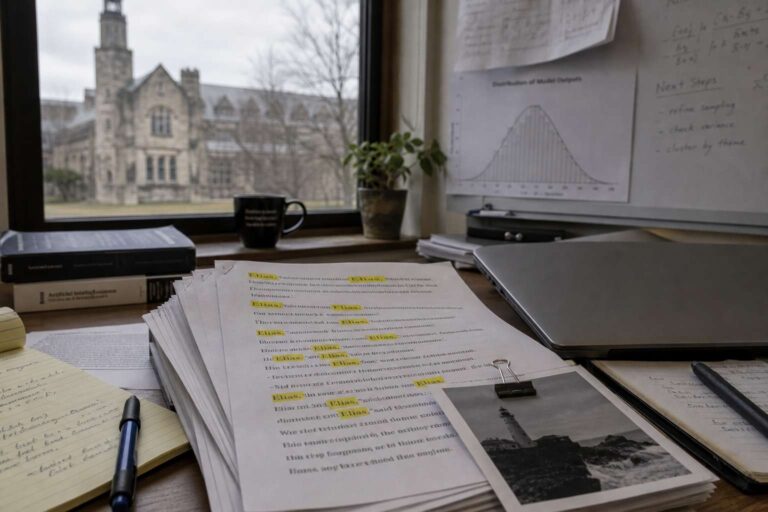
A Cornell University preprint published in late May found that frontier AI models often default to the same fictional setup when given minimal creative direction. When prompted to “write a story” with no added detail, the same 11 words appeared 88.3% of the time, frequently centered on a lighthouse keeper named Elias Thorne. Google Trends showed searches for the name were flat through late 2025 before spiking to an all-time peak in early 2026.

Software engineer Daniel May first noticed the pattern after testing chatbots with the prompt “Write a story in 10 sentences.” Across eight models, four produced a lighthouse keeper and two named him Elias. Cornell researchers later sampled 20,000 stories from four current models and found that “Elias” appeared in 26.5%, “Mara” in 16.7% and “Elara” in 13.1%.

The researchers hypothesize that Elias traces back to WildChat, a dataset of 1 million real GPT-3.5 conversations that included 166 conversations featuring the character in a lighthouse-style story. As models trained on the dataset and newer datasets reused model outputs, the pattern spread. Alignment training may have reinforced the drift by steering systems away from copyrighted characters and adult content, leaving a bland placeholder who appears 900 times more frequently in AI-generated stories than in a corpus of 2,700 contemporary novels.
56

Impact Score

DUDE Wipes finds AI gains in logistics and hiring

DUDE Wipes is using AI across operations, marketing and hiring as brands face tougher questions about returns from generative tools. The company points to supply chain automation as one area producing measurable time savings.

Nvidia readies Grace CPU for AI systems beyond x86

Nvidia is developing Grace, its first data center CPU, to link more tightly with its GPUs as AI model sizes grow. The Arm-based chip is aimed at future systems where CPU-to-GPU bottlenecks become a bigger constraint.

AI labeling rules raise questions for newsrooms

New York and EU policy efforts are pushing AI disclosure into news and public-interest content. The hardest unresolved issue is how to label work shaped by both human judgment and AI systems.

Rail weighs AI benefits against assurance risks

AI could improve rail operations, safety monitoring and documentation work, but rail deployments need stronger safeguards than generic tools provide. Human validation, traceability and secure handling of sensitive data remain central concerns.

Cisco expands secure AI networking with NVIDIA systems

Cisco is adding NVIDIA-powered switching, unified management, and DPU-based firewall enforcement to support larger AI data center deployments. The portfolio targets enterprises, neoclouds, and sovereign cloud providers building high-performance AI infrastructure.

Contact Us

Got questions? Use the form to contact us.

Contact Form

Clicking next sends a verification code to your email. After verifying, you can enter your message.