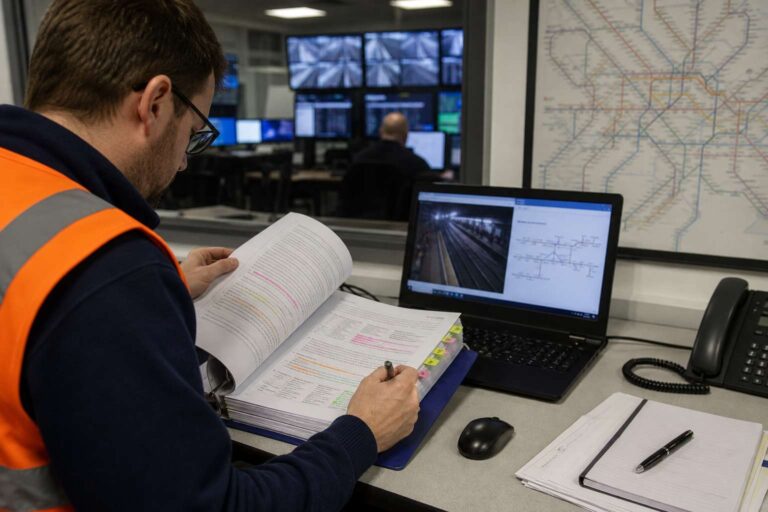
AI is already changing industry decision-making, but rail engineering faces specific risks from systems that can produce plausible errors, biased outputs or fabricated information. Examples include chatbots making unintended commitments, legal research tools generating fake case references, and AI-generated rail imagery showing misleading infrastructure details after incidents.
Rail applications could benefit from AI analysis of CCTV, operational data and historic records, helping detect platform incidents, animals near tracks and patterns that support better decisions. Safety-critical use remains constrained, with AI considered unlikely to be used above SIL 1 for some time. At Westbourne Park on Crossrail, AI assists an auto reverse function while conventional SIL 4 signalling architecture provides the high-integrity control.
Assurance work is another promising area, but generic AI tools are not designed for regulated environments and may lack standards knowledge, evidence links and data protections. Purpose-built systems need traceable outputs, secure input handling and audit trails. IEEE guidance emphasizes transparency, accountability, privacy and human values, while risks from vibe coding and AI-generated software show why competent human review remains essential.