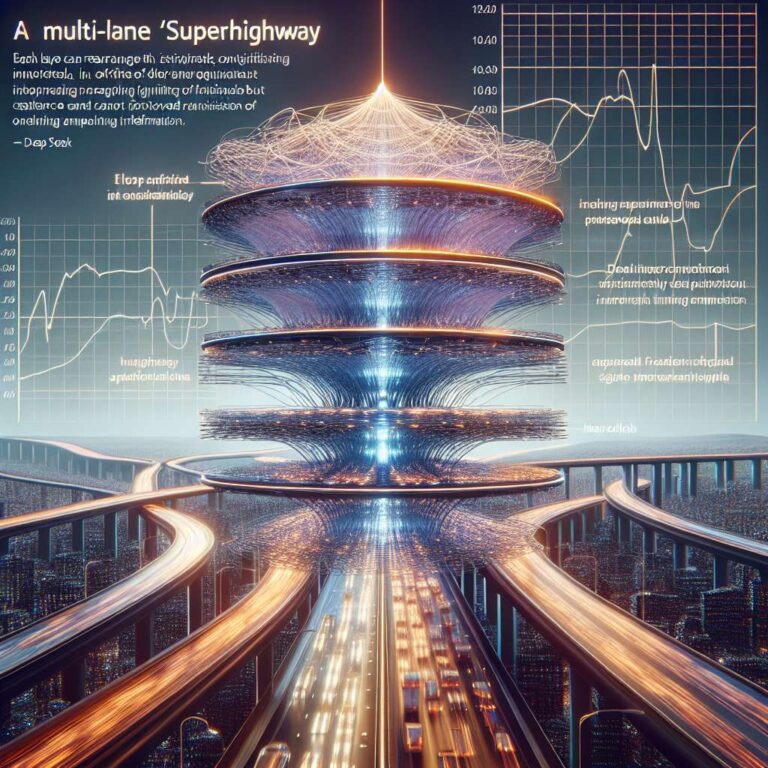
Chamath Palihapitiya’s weekly reading recap focuses first on a new paper from DeepSeek that proposes a fresh architecture for large artificial intelligence models. The work, titled Manifold-Constrained Hyper-Connections and presented by chief executive Wenfeng Liang, targets a long-standing bottleneck in how information travels inside these systems. According to the summary, for the last decade, all artificial intelligence models have used a single, narrow “express lane” to pass information between their internal layers, which has constrained how much data can move through the network at once and limited efficiency and capability.
The DeepSeek paper, referred to as mHC, is described as a blueprint for converting that single internal lane into a multi-lane “superhighway”, allowing much more information to flow through the artificial intelligence at once. Previous attempts to widen these internal highways reportedly caused models to become “unstable” and crash because the data streams became too chaotic. DeepSeek is said to address this by adding mathematical guardrails, captured in the “Manifold” concept, which limit how streams are mixed so that each layer can only rearrange information rather than amplify it. This constraint is intended to keep the model stable across many layers while preserving richer internal signals and combinations.
The summary notes that this structural change delivers small but consistent accuracy gains with little added cost, and it argues that carefully preserving and combining information through better internal design can yield real performance advantages without requiring larger or more expensive models. The result is an artificial intelligence that is characterized as significantly more powerful and better at handling complex details, while costing almost nothing extra to build or run. In the second item, Palihapitiya turns to macroeconomics, explaining that on December 31, 2025, two federal reserve facilities spiked to new ATHs this year, with the Standing Repo Facility showing 74.6B Borrowed and the Reverse Repo Facility showing ~106B Parked. He explains that the standing repo facility is an “Emergency Credit Line” that puts a ceiling on interest rates, while the reverse repo facility serves as a “Savings Account” that helps set a floor under rates. The spikes are framed as a year-end balance-sheet effect rather than a sign of ongoing stress, as banks temporarily move cash and collateral to optimize regulatory reporting before trades unwind and markets normalize on January 1.