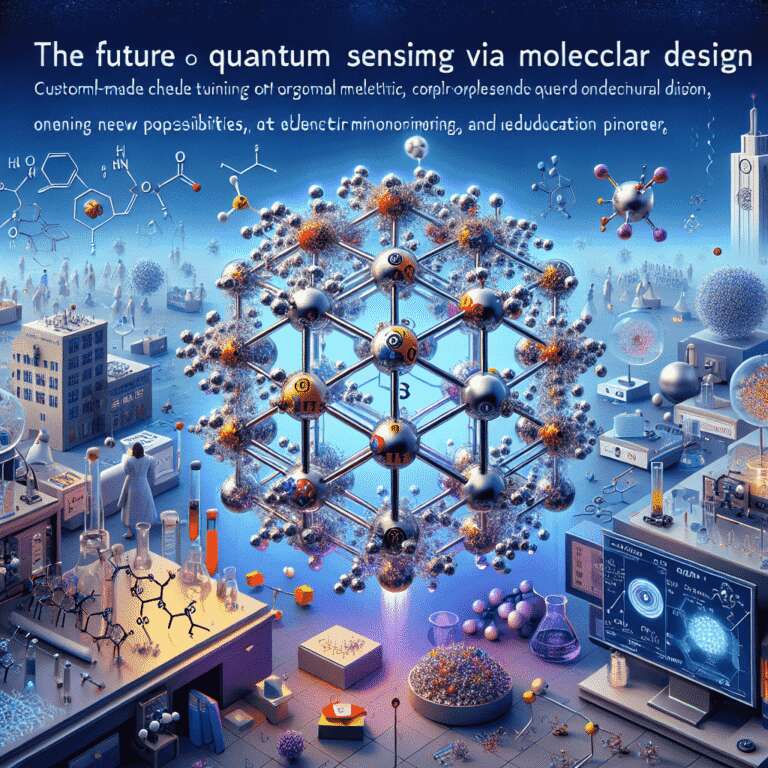
Danna Freedman, a Frederick George Keyes Professor of Chemistry at MIT and recipient of a 2022 MacArthur fellowship, has emerged as a leader in quantum information science by creating custom molecules that function as qubits. Inspired by early exposure to molecular models at Harvard, Freedman´s career has intertwined chemistry and quantum technology, focusing on the link between molecular structure and function. Her innovative research at MIT leverages specially designed molecules to serve as quantum sensors rather than just computational qubits, with the aim of achieving ultra-precise measurements at the atomic scale.
Freedman distinguishes her approach by using chemistry to engineer molecular qubits with properties tailored for specific sensing environments. Traditional qubits, such as superconducting and ion-trap types, typically require extreme conditions like near-absolute-zero temperatures and are difficult to scale. Freedman´s strategy is a ´bottom-up´ molecular design, where the target application—such as measuring minuscule magnetic fields or operating in varying chemical environments—dictates the properties of the molecule. These molecular qubits, often based on organometallic complexes like chromium surrounded by hydrocarbons, store quantum information in electron spin and can be tuned at the atomic level to react sensitively to environmental changes. Their nanometer-scale size allows closer proximity to the phenomena being measured, offering accuracy advantages in environmental monitoring, medical diagnostics, and materials science.
The Freedman lab exemplifies interdisciplinary collaboration, melding chemistry, physics, engineering, and even biology to advance quantum sensing. Freedman values MIT’s cross-disciplinary culture, which fosters connections with neurobiologists, theoreticians, and material scientists to expand the practical reach of quantum sensors. Inside her MIT lab, students and postdoctoral researchers synthesize and characterize new molecules, analyze their quantum properties, and iterate their designs for robustness in real-world environments. Freedman’s educational philosophy is equally innovative; she demystifies chemistry for students with hands-on demonstrations, ´molecule of the day´ lectures, and encouragement to embrace both ambitious and pragmatic projects. By blending curiosity-driven research with practical challenges, she cultivates an environment where even dead-end results fuel new discoveries and technological breakthroughs in quantum science.