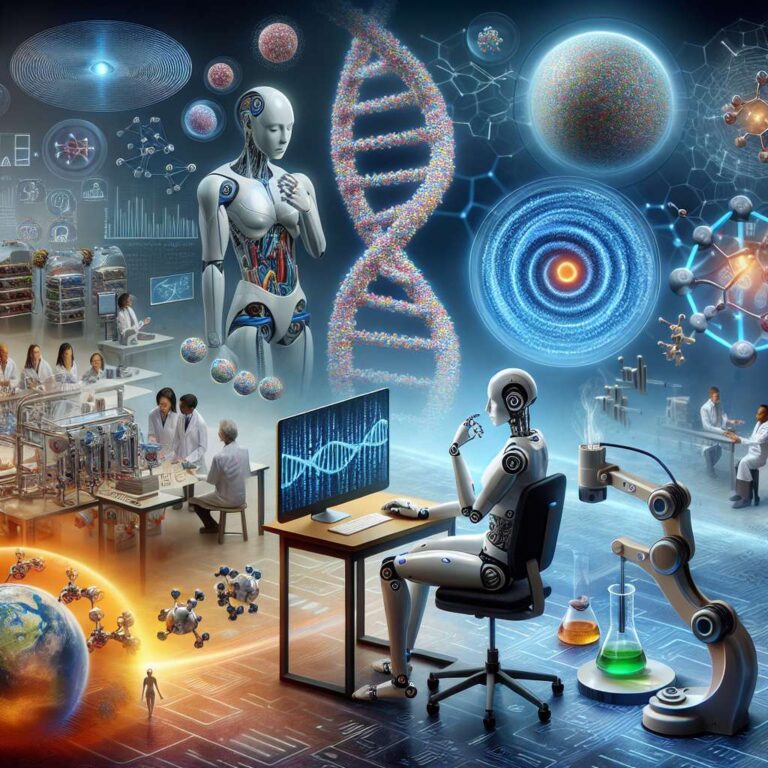
Artificial Intelligence is accelerating scientific research across biology, materials, meteorology, physics, mathematics, and computing. The article highlights Google DeepMind as a leading force, citing AlphaFold as a turning point that solved protein structure prediction and “won the 2024 Nobel Prize in Chemistry,” and describing downstream systems such as AlphaProteo and AlphaMissense that help connect “target discovery – structure analysis – drug design.” DeepMind’s WeatherNext 2 model is presented as more accurate than the HRES system of the European Centre for Medium – Range Weather Forecasts (ECMWF) in 99.9% of prediction variables and time spans while improving inference speed by several orders of magnitude. Models such as GNoME and AlphaQubit are extending applications into materials discovery and quantum error correction.
Biology is portrayed as the most active frontier of scientific intelligence because of abundant data and clear application scenarios. The article references the 27 – billion -parameter single – cell analysis foundation model C2S – Scale, jointly released by Google and Yale University, which generated hypotheses about cancer cell behavior verified in vitro. Microsoft’s BioEmu reportedly boosted protein dynamics simulation speed by up to 100,000 times. The piece documents applied medical advances: the DeepGEM pathological large model can predict lung cancer gene mutations within 1 minute with an accuracy rate of 78% – 99%; Google’s DeepSomatic toolset improves somatic mutation identification; and the AI-optimized candidate drug MTS – 004 completed Phase III clinical research, targeting neurological diseases such as amyotrophic lateral sclerosis and stroke.
The article frames a shifting research paradigm around the “foundation model + scientific research agent + autonomous laboratory” architecture. It contrasts general large – foundation models acting as operating systems with specialized models for vertical domains, and highlights agent platforms such as ToolUniverse with more than 600 scientific tools and AlphaEvolve as an evolutionary agent applied to chip design and scheduling. Autonomous laboratories and platformization are accelerating industrialization, with international academic and startup activity and financing of “hundreds of millions of dollars.” The author notes ethical and capability considerations and cites a prediction that Artificial Intelligence large – models could enable discoveries comparable to the theory of relativity by 2028.