
Bionic knee integrated with muscle and bone restores more natural movement

MIT researchers unveiled a bionic knee that anchors to bone and taps into residual muscle signals, improving mobility for people with above-the-knee amputations. Early clinical results show faster walking, better stair climbing, and a stronger sense of limb ownership compared with socket-based prostheses.

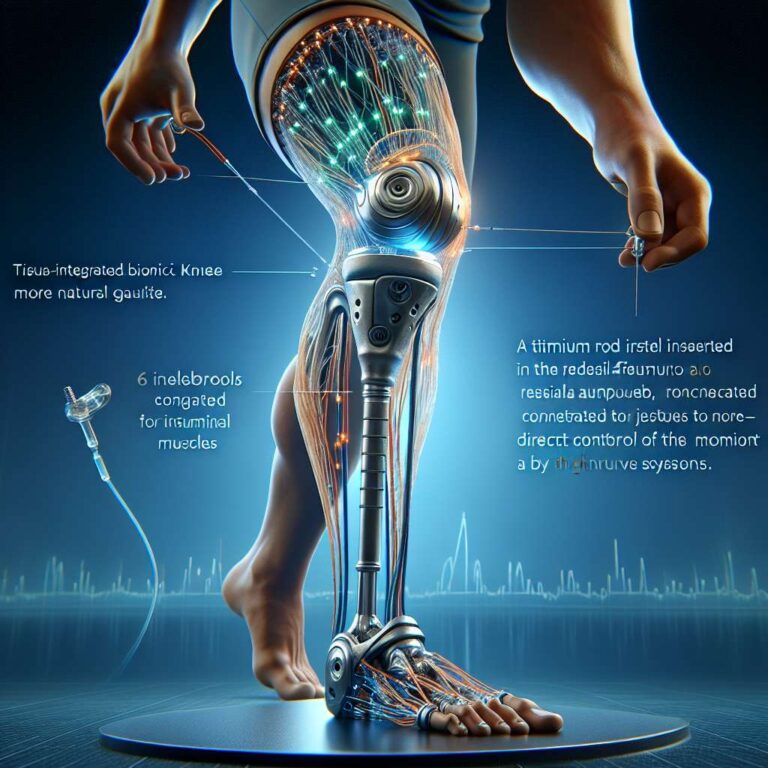
MIT researchers have developed a bionic knee that is directly integrated with a user’s muscle and bone tissue, aiming to restore a more natural gait for people with above-the-knee amputations. Unlike traditional socket-based prostheses, which can be uncomfortable and limit stability, the new system anchors to the residual femur and is controlled by the nervous system. Early evidence suggests users can walk faster, climb stairs, and navigate obstacles with greater ease, reflecting improvements in both mechanical support and intuitive control.

The work builds on techniques pioneered by Hugh Herr, co-director of the K. Lisa Yang Center for Bionics, to extract neural information from residual muscles after amputation. Known as the agonist-antagonist myoneuronal interface, or AMI, this method has previously helped people with below-the-knee amputations move more naturally. In the latest study focused on above-the-knee amputations, surgeons inserted a titanium rod into the residual femur. The implant improves load bearing and mechanical control while housing 16 wires that relay signals from electrodes on AMI muscles inside the body, enabling more precise neuroprosthetic control of the limb.

In a clinical study, two recipients of the implant outperformed peers using conventional above-the-knee prostheses on multiple tasks, including stair climbing, and reported that the limb felt more like part of their own body. As Hugh Herr describes it, a prosthesis that is tissue-integrated and directly controlled by the nervous system becomes an integral part of self rather than a separate device. The research team notes that larger clinical trials will be required to secure FDA approval for commercial use, a process they estimate could take about five years.
55

Impact Score

Artificial Intelligence divides employers as hiring and headcount shift

U.S. hiring beat expectations in April, but employers remain split on whether Artificial Intelligence should drive layoffs, productivity gains, or internal redeployment. At the same time, candidate use of Artificial Intelligence is outpacing employer adoption in hiring, adding new pressure to screening and entry-level recruiting.

What businesses need to know about the EU cyber resilience act

The EU cyber resilience act is turning product cybersecurity into a legal requirement for companies that sell digital products into the European Union. A key compliance milestone arrives in September 2026, well before the full regulation takes effect in 2027.

Claude Mythos and cyber insurance’s next inflection point

Claude Mythos is being treated by governments and regulators as a potential systemic cyber risk with implications for financial stability and insurance markets. Its emergence is intensifying pressure on insurers to clarify whether Artificial Intelligence-enabled cyber losses are covered, excluded, or require new stand-alone products.

OpenAI expands ChatGPT ads with self-serve manager

OpenAI is widening its ChatGPT ads pilot with a beta self-serve Ads Manager, new bidding options and broader measurement tools. The push signals a deeper move into advertising as the company expands the program into several international markets.

Contact Us

Got questions? Use the form to contact us.

Contact Form

Clicking next sends a verification code to your email. After verifying, you can enter your message.