Structural biology is entering a new phase beyond the original breakthrough of AlphaFold 2, with two emerging frontiers poised to redefine the field: the prediction of full protein conformational landscapes and the routine de novo design of high-affinity protein binders. Predicting the most stable folded forms of protein domains and monomers became largely solved, and newer models extended that progress to assemblies containing proteins, nucleic acids, ligands and ions. Yet major limitations remain. Modeling complexes is still far from solved, nucleic acid prediction remains in a pre-Artificial Intelligence era, protein-ligand co-folding suffers from memorization and physics-related problems, and even protein-only multimers such as antibody-antigen complexes are not yet predicted with high reliability.
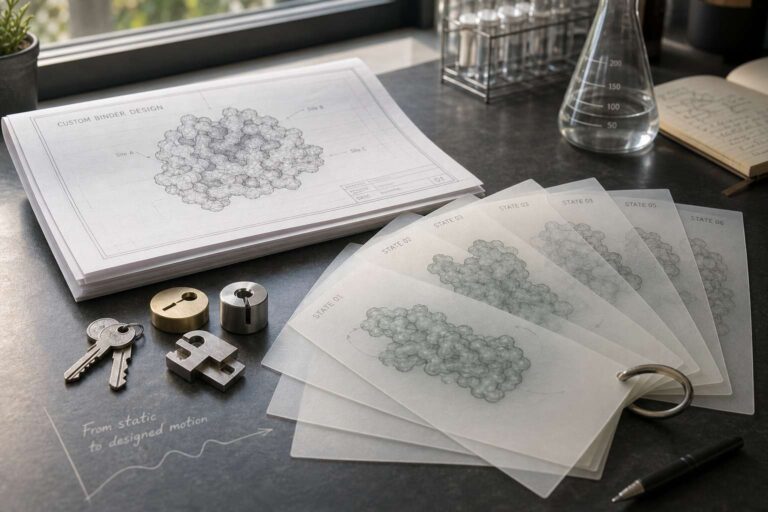
A central next step is to move from static structures to full conformational landscapes that capture the range of states proteins can adopt and their relative populations. CASP has elevated this challenge through dedicated tracks and a special interest group, although results so far have been limited. New approaches emerging during 2025 aim to approximate Boltzmann-weighted ensembles more directly. Microsoft’s BioEmu is highlighted as a leading example because its training combined structural databases with 200 ms of all-atom MD simulations and because its diffusion-based design is built to sample distributions rather than output a single structure. When BioEmu runs on a protein sequence, it predicts thousands of models, with more stable states appearing more frequently. Presumably, what would take 100,000 GPU hours of atomistic MD can be emulated in minutes. Concerns remain around memorization, bias from sequence alignments and templates, and the fact that sidechains are modeled in a separate stage.
Protein design is advancing in parallel, especially for binders. Designing functional sequences has long been restricted to expert groups, but binder design is becoming more like an engineering workflow. Historically, finding a binder for a protein would take months of library screening or animal immunization, and the output would be limited to antibody or antibody-like proteins. Tools such as BindCraft now use AlphaFold-derived architectures as a fitness oracle for de novo binder creation, with strong wet-lab validation. In Adaptyv Bio’s latest competition on Nipah virus neutralization, a >8% hit rate was achieved over the full set of submissions, including 26 single-digit nanomolar or stronger binders10. A closed-loop pipeline managed by an Artificial Intelligence agent built from Claude to control Boltz-2 also produced one binder with nanomolar affinity. Predicting binder affinity itself, however, still lags behind.
A separate but equally important shift is making these tools easier to use. ColabFold was a turning point because it removed installation and hardware barriers from AlphaFold 2, and similar patterns now extend across biology and chemistry. Platforms such as HuggingFace, Nvidia’s hosted model services, and Tamarind Bio are packaging advanced systems for browser-based or API-driven use, including BioEmu and BindCraft. At the same time, increasingly capable multimodal reasoning systems are helping users inspect structures, interpret outputs, generate code, and even automate experimental loops. Together, these developments point to a future in which dynamic ensemble prediction, programmable protein design, and agent-assisted analysis become core capabilities across structural biology.