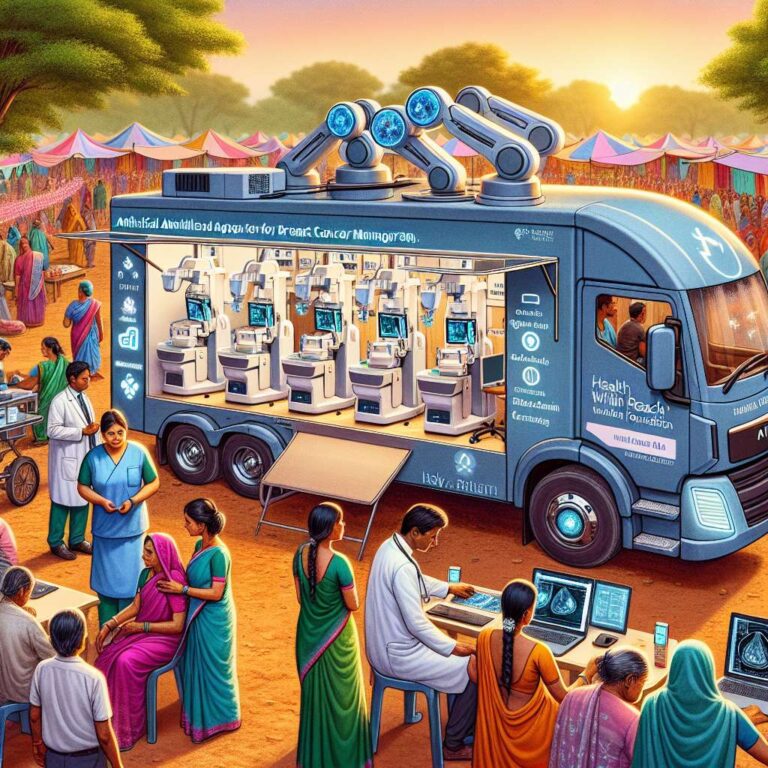
An unassuming mobile clinic operated by the Health Within Reach Foundation is using Artificial Intelligence from MedCognetics to expand access to breast cancer screening across rural areas around Pune, India. The digital mammography van has screened data from more than 3,500 patients, about 90% of whom had never had a mammogram before. Of those scans, roughly 8 percent, around 300 cases, returned abnormal findings, and MedCognetics’ software identified 24 cancer-positive patients who were connected to treatment before the disease progressed further. Foundation and company leaders emphasize that the program brings high-quality care closer to patients and reduces load on urban healthcare institutions.
MedCognetics produces software that is cleared by the U.S. Food and Drug Administration as software as a medical device. The company’s breast cancer screening suite includes algorithms for cancer triage and modular features being prepared for regulatory submission, such as cancer detection, breast density assessment, and a one-year risk analysis model. The software can run on NVIDIA IGX Orin industrial-grade edge platforms with the NVIDIA Holoscan runtime for real-time sensor processing, or on NVIDIA Tensor Core GPUs hosted in the cloud. The team is also developing image denoising capabilities with IGX Orin integration to reduce motion artifacts and present clearer images to radiologists.
Rapid Artificial Intelligence inference using India-based cloud resources lets screening staff quickly flag high-risk cases and prioritize radiologist review. Radiologists do not travel with the vans; images are uploaded to the system when the van returns to its urban hub so experts can perform prioritized reporting. When the software flags a potential tumor, the team immediately connects the patient to a radiologist for detailed analysis and referral. Program leaders highlight the importance of detecting very small tumors and the potential for future onboard edge Artificial Intelligence to enable onsite triage in remote areas with limited connectivity. For a country where a large share of the population lives in rural communities and where many diagnoses occur at advanced stages, the mobile screening program aims to improve early detection through accessible, affordable mammography services.