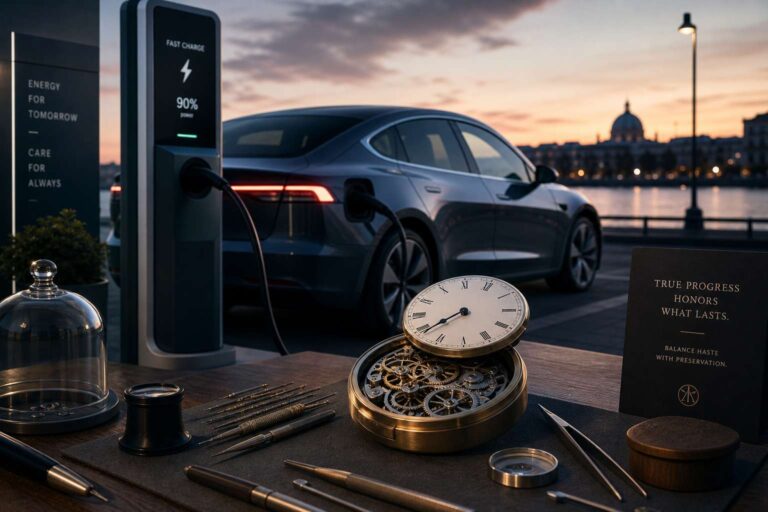
Researchers at Chalmers University of Technology have developed a new Artificial Intelligence-based charging method that could help electric vehicle batteries last longer without increasing charging time. According to the researchers, the new charging system improved battery lifespan by 22.9% compared with traditional charging methods. The approach addresses a central challenge for electric transportation: allowing drivers to charge quickly while reducing long-term damage inside battery cells.
Battery health remains one of the biggest concerns for electric vehicle buyers, because replacement can be expensive and frequent fast charging can stress battery cells over time. According to data collected by Recharged, most Tesla batteries still keep around 85% to 90% of their original capacity after driving nearly 200,000 miles. Some Tesla vehicles may even reach 300,000 to 400,000 miles before battery capacity drops to 70%.
The researchers used reinforcement learning, a machine learning method in which a system tests actions and improves based on results. Instead of applying the same charging pattern every time, the Artificial Intelligence system studies the battery’s charge level, age, overall health, and charging history before charging begins. It then adjusts the charging current in real time, unlike traditional systems that rely on fixed current and voltage settings regardless of battery condition.
Using the Artificial Intelligence-based charging strategy, researchers achieved a 22.9% increase in battery lifetime measured in equivalent full charging cycles. The average charging time using the Artificial Intelligence system was 24.12 minutes. Traditional charging methods averaged 24.15 minutes. The method is designed to reduce lithium plating, a damaging process that can occur during fast charging when metallic deposits form on the battery surface instead of lithium being stored correctly. The study, titled “Lifelong Reinforcement Learning for Health-Aware Fast Charging of Lithium-Ion Batteries”, was published in IEEE Transactions on Transportation Electrification and led by Changfu Zou and Meng Yuan.
Real-world testing on physical battery packs and vehicles is still needed before automakers can fully adopt the technology. According to Grand View Research, the global EV charging infrastructure market was worth about $40.22bn in 2025. It could grow to $50.2bn in 2026 and eventually reach nearly $239bn by 2033. The market is expected to grow at a compound annual growth rate (CAGR) of 25%. Fast chargers already dominate the market, accounting for more than 73% of charging infrastructure in 2025. Researchers say the charging method could be added through software updates in existing battery management systems, though calibration would be needed for different battery chemistries and vehicle designs.