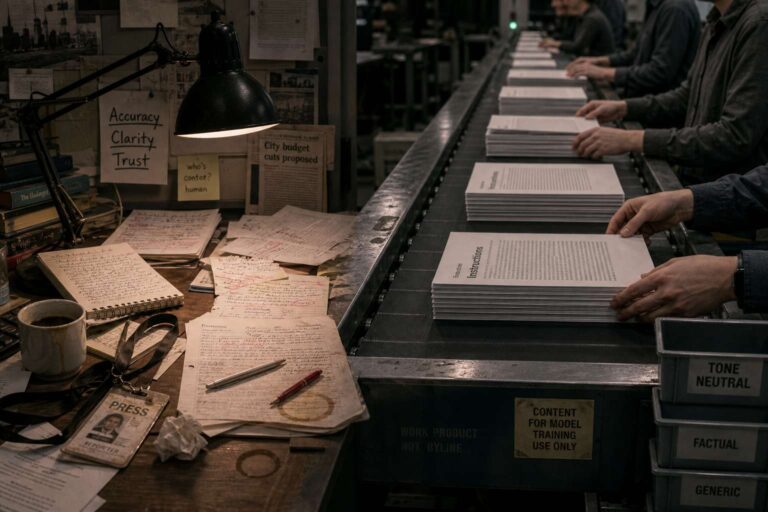
Artificial Intelligence companies are recruiting people with editorial judgment to improve chatbot and model outputs, asking them to assess accuracy, clarity, structure, tone and natural language. Those requirements overlap closely with core journalism skills, drawing freelance reporters and editors into work that includes reviewing Artificial Intelligence-generated text, checking sources, correcting hallucinations, labelling video errors and refining multilingual responses.
Darius Osborne, a Howard University graduate who could not secure an entry-level newsroom role, became a data labelling analyst for Meta while continuing to freelance. His work involves reviewing Artificial Intelligence-generated videos, prompts or hooks and labelling whether they meet quality standards, including clarity, visual artifacts, surreal-looking errors or inappropriate content. In Canada, Khaleda Khan spent four to five months searching for entry-level media work after graduating in late 2024 before joining xAI as a trainer for the company’s Artificial Intelligence chatbot, Grok. For the six months Khan was at xAI, her job centered on improving Artificial Intelligence systems through a mix of transcription, linguistic review, and quality control, or being an editor of a robot.
Bisma Farooq has been a freelance journalist in India for the past five years. She turned to Artificial Intelligence training and data annotation for Invisible Technologies to supplement income, but found the commission-based work technical, repetitive and creatively draining. Bettina Blass has been a freelance journalist in Germany since 2003. For a year and a half, Blass worked with the startup on an Artificial Intelligence editing tool that automatically turns incoming press releases, police alerts or community notices into journalistic news articles, writing prompts that taught the system basic news structures such as the inverted pyramid.
The pay picture varied sharply. Khan and Osborne found tech-company work more financially stable and more lucrative than freelancing, while Blass and Farooq said their Artificial Intelligence assignments paid less than journalism. The ethical tension was also clear: several journalists worried they were helping build systems that could compete with them, even as the work gave them experience in a changing labor market.
Close exposure to the technology left the journalists skeptical that machines can fully replace human reporting. They described Artificial Intelligence systems as dependent on human labor, prone to bias, errors and hallucinations, and unable to reproduce the judgment, creativity and emotional perspective central to journalism. The most optimistic view cast Artificial Intelligence as useful for routine tasks such as press releases or sports scores, freeing reporters to focus on higher-value work while requiring closer collaboration between engineering and editorial teams.