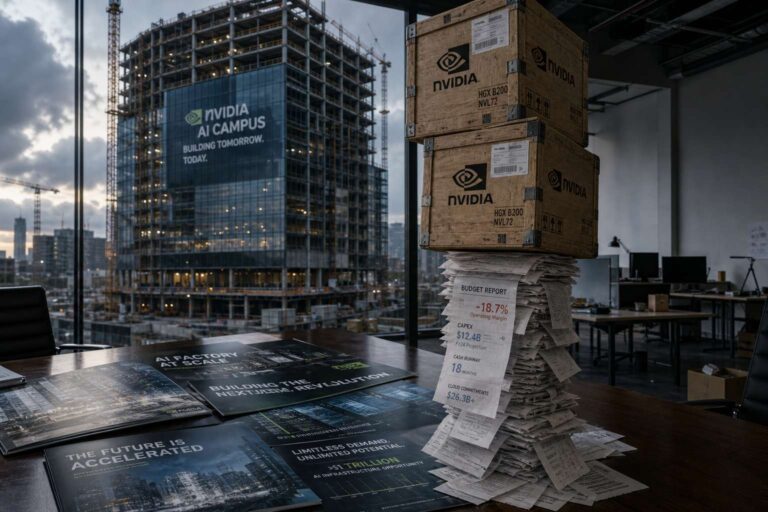
The case against the generative Artificial Intelligence boom centers on a gap between promised transformation and practical performance. Large-language models are real and do some things, but they do not do what Dario Amodei describes when he says that Artificial Intelligence will wipe out 50% of white collar jobs. The industry is depicted as relying on claims about what systems may eventually do, while current products remain inconsistent, unreliable and difficult to measure for return on investment.
The economics are presented as especially fragile. In reality, 89%+ of all Artificial Intelligence revenues and 90%+ of all compute demand comes from two companies, OpenAI and Anthropic, largely based on money-losing subsidized Artificial Intelligence subscriptions and unrestrained token burn. Enterprises are already capping their Artificial Intelligence spend after multiple companies blew through their annual token budgets in a few months. The total, actual revenue of the entire Artificial Intelligence industry, including OpenAI, Google, Microsoft, Amazon, and Anthropic, has barely reached $100bn in 2026. That includes every ounce of compute spend, every penny of the $500mn that a single customer accidentally spent on Anthropic’s API, and every cent of NVIDIA’s backstop deal with CoreWeave.
Technical limits are tied to hallucinations, with generative Artificial Intelligence described as probabilistic software that guesses at outputs rather than knowing facts or making reasoned decisions. Coding is treated as the strongest claimed use case, yet the benefits are portrayed as unclear: not reliably saving money, not clearly saving time, and not consistently improving products. Outside coding, examples are described as vague, including possible agents at Goldman Sachs and Novo Nordisk integrating ChatGPT models to analyze complex data sets.
The infrastructure buildout is framed as another sign of financial overreach. Major data center borrowing included $178.5bn in data center debt deals in the US in 2025 and $50bn in data center construction in April 2026 alone. Data centers take anywhere from 18 to 36 months to build, with Microsoft finishing a grand total of zero of the data centers it broke ground on in 2023, and JP Morgan saying a month ago that 60% of capacity planned for completion in 2027 hasn’t even started construction, with another 7% delayed. Despite the supposed 100GW+ of data center capacity being planned, Artificial Intelligence compute demand is described as concentrated around Anthropic and OpenAI. NVIDIA’s continued growth relies on a dwindling subset of clients, with 54% of its last quarter’s revenue and 64% of its accounts receivable coming from three customers in its last quarterly earnings.