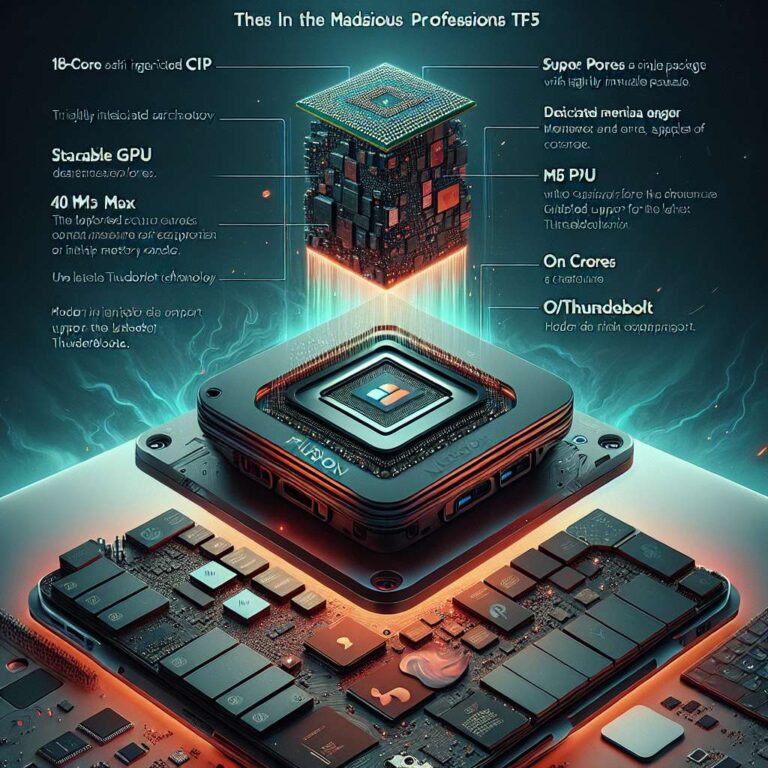
Apple introduced the M5 Pro and M5 Max processors as new high-end chips for professional laptops, serving as the core of the latest MacBook Pro lineup. The processors are built on a new Apple-designed Fusion Architecture that combines two dies into a single system on a chip, integrating a CPU, scalable GPU, Media Engine, unified memory controller, Neural Engine, and Thunderbolt 5 support. By tightly coupling these components on one system on a chip, the design targets demanding pro workflows that require both high performance and efficient data sharing between compute units.
The M5 Pro and M5 Max feature a new 18-core CPU architecture that includes six super cores described as the highest-performing core design and positioned as the world’s fastest CPU core. Alongside these are 12 all-new performance cores that are optimized for power-efficient, multithreaded workloads to handle heavy parallel tasks. According to Apple, the combined CPU configuration significantly boosts performance by up to 30 percent for pro workloads, aiming to deliver faster processing in applications such as content creation, development, and data-intensive tasks without sacrificing energy efficiency.
The GPU extends the next-generation graphics architecture introduced in the earlier M5 chip to an up-to-40-core GPU configuration. With a Neural Accelerator embedded in each GPU core and higher unified memory bandwidth, M5 Pro and M5 Max are over 4x the peak GPU compute for Artificial Intelligence compared to the previous generation. The GPU substantially increases graphics capabilities, delivering up to 35 percent gains for applications using ray tracing than M4 Pro and M4 Max, which is intended to enhance advanced visual effects and 3D rendering workloads. With these processors, the new MacBook Pro is positioned as a powerful option for professional users and is available for pre-order starting tomorrow, with availability beginning Wednesday, March 11.