
AMD Medusa Halo APU set to pair Zen 6 and RDNA 5 with LPDDR6 memory

AMD’s upcoming Medusa Halo Ryzen Artificial Intelligence MAX APU is rumored to combine up to 24 Zen 6 cores and 48 RDNA 5 compute units with a wide LPDDR6 interface. Early LPDDR6 modules from Samsung and Innosilicon highlight the bandwidth and efficiency gains this platform could tap.

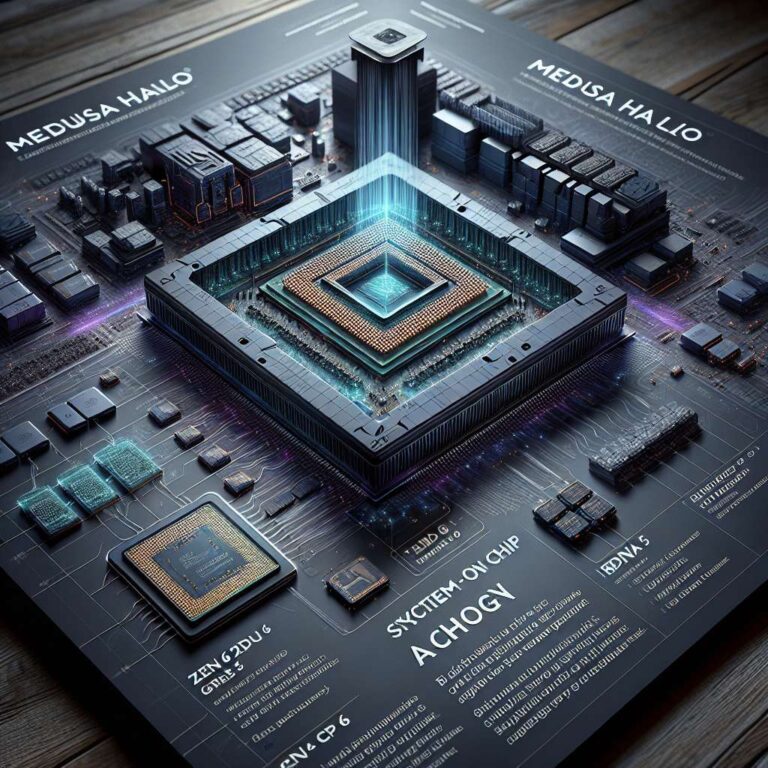
AMD’s next major refresh of Ryzen Artificial Intelligence MAX APUs, codenamed Medusa Halo, is expected to be among the first system-on-chips to adopt LPDDR6 memory. Leaked details indicate the silicon could feature a 384-bit bus powering LPDDR6 memory, which would translate into massive bandwidth for a new CPU and GPU configuration. The platform is rumored to scale up to 24 Zen 6 CPU cores alongside 48 RDNA 5 or UDNA compute units for the integrated graphics. With these specifications paired to the added bandwidth from LPDDR6 memory, Medusa Halo is positioned as one of the best-performing APUs in its class when it launches.

LPDDR6 is beginning to move from roadmap to validation, with memory manufacturers such as Samsung and Innosilicon already shipping modules to customers for testing. Innosilicon’s LPDDR6 modules boast an impressive speed of 14.4 Gbps, significantly faster than Samsung’s initial modules, which achieve 10.7 Gbps. Innosilicon’s modules offer a 1.5x increase in IO speed capability compared to the 9.6 Gbps of LPDDR5X previously available, along with improved efficiency. These gains underline why a bandwidth-hungry APU like Medusa Halo could benefit substantially from the new standard.

The LPDDR6 specification also brings architectural changes that further expand throughput. The latest LPDDR6 also increases the number of bits per byte of IO from 8 to 12. This results in LPDDR6’s bandwidth at a single-channel 24-bit I/O speed being double that of LPDDR5X at a 16-bit single-channel. To support expected demand, Innosilicon is reportedly collaborating with TSMC and Samsung to ensure sufficient production capacity for LPDDR6 IP, while Samsung is relying on its own fabs to manufacture LPDDR6 memory. Together, these developments set the stage for high-bandwidth APUs such as Medusa Halo to leverage LPDDR6 at volume.
55

Impact Score

EU delays key Artificial Intelligence Act deadlines

The European Union has provisionally agreed to revise the Artificial Intelligence Act, delaying several major compliance deadlines and narrowing some obligations. The changes give businesses more time to prepare while preserving the law’s overall high-risk framework.

Empirical Research Assistance automates scientific coding

Empirical Research Assistance, a system developed by researchers at Google and Harvard, automatically writes and refines scientific software for scorable research tasks. Tests showed it could outperform expert-built programs across problems including COVID-19 forecasting, neural modeling, and single-cell RNA sequencing analysis.

Google unveils new Artificial Intelligence models and personal agents

Google used its I/O developer conference to introduce updated Gemini models and personal Artificial Intelligence agents aimed at competing more aggressively with OpenAI and Anthropic. The push centers on stronger models, wider product integration, and a broader enterprise and developer pitch.

Policymakers weigh pause on Artificial Intelligence data center construction

Federal, state, and local officials are moving to slow or condition large data center development as concerns grow over electricity costs, grid strain, environmental effects, and labor standards. Proposed moratoriums and tax incentive changes are creating new uncertainty for developers, hyperscalers, and financiers.

Contact Us

Got questions? Use the form to contact us.

Contact Form

Clicking next sends a verification code to your email. After verifying, you can enter your message.