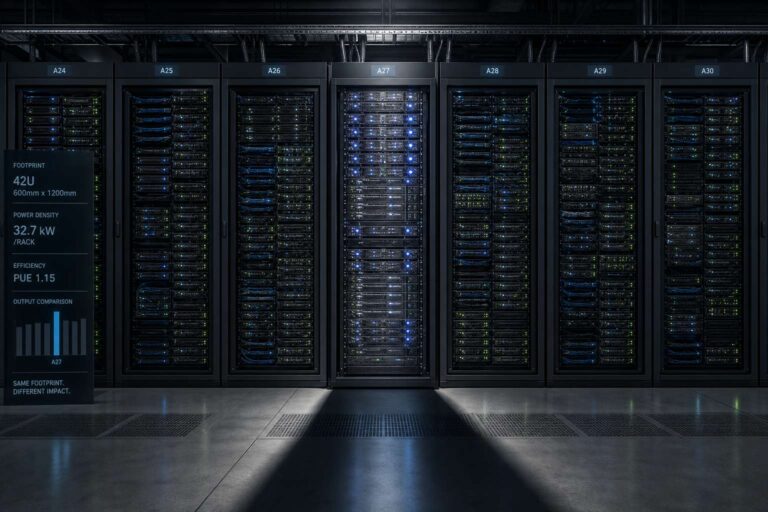
AMD released new server CPU benchmarks positioning its EPYC processors as a key platform for agentic Artificial Intelligence workloads, where software agents coordinate databases, web services and orchestration tools across constrained data center racks. The company argues that rack-level throughput, power use, cooling demands and physical density matter more than isolated chip-level performance as infrastructure shifts toward agent-driven systems.
In a modeled 100-kilowatt rack scenario, AMD’s current-generation EPYC 9965 processor delivered roughly 2.37 times the rack-level throughput of Nvidia’s forthcoming Vera CPU platform. The lead widens with AMD’s next-generation EPYC Venice chip, built on the Zen 6 architecture, which is projected to stretch that advantage to 3.3 times over Vera. Against Intel’s Xeon 6980P Granite Rapids-AP processor, the EPYC 9965 turned in a 1.6x throughput lead. Even Intel’s current silicon showed a 1.46x advantage over Nvidia Vera in the same set of benchmarks.
AMD’s test suite focused on the types of workloads that support agentic Artificial Intelligence, including SPEC CPU 2017, a SPECjbb2015-derived Java workload, NGINX and WRK web-serving tests, redis-benchmark, Memcached and memtier_benchmark, and a TPC-C-derived OLTP proxy on MySQL. Rack density was another focus: current EPYC Turin systems can pack more than 27,000 CPU cores into a single rack, while the upcoming Venice generation is projected to exceed 36,000 cores. Nvidia’s Vera-based racks, by comparison, top out around 22,500 cores.
Single-threaded performance also tilts in AMD’s favor according to the company’s projections. A 64-core Venice part is expected to deliver a 27% per-core performance advantage over Nvidia’s 88-core Vera configuration. Even the higher-core-count 96-core Venice models are projected to hold an 11% single-core lead.
The benchmarks arrive during a pullback in semiconductor stocks. AMD shares fell 3.92% on Wednesday, caught in a broader tech sell-off that has trimmed the stock by roughly 9.3% over the past five trading sessions. Despite the pullback, AMD remains up more than 113% year-to-date and has surged roughly 293% over the past twelve months. AMD management has pegged agentic Artificial Intelligence infrastructure as a $120bn market opportunity over the next several years, while Nvidia has suggested it could reach $200bn.