
Ambersemi tapes out Powertile vertical power solution for artificial intelligence data centers

Amber Semiconductor has completed silicon tape out for its Powertile vertical power delivery device, designed to feed artificial intelligence processors in data centers from directly beneath the package. The company claims the approach sharply cuts distribution losses and removes a key bottleneck in scaling processor power.

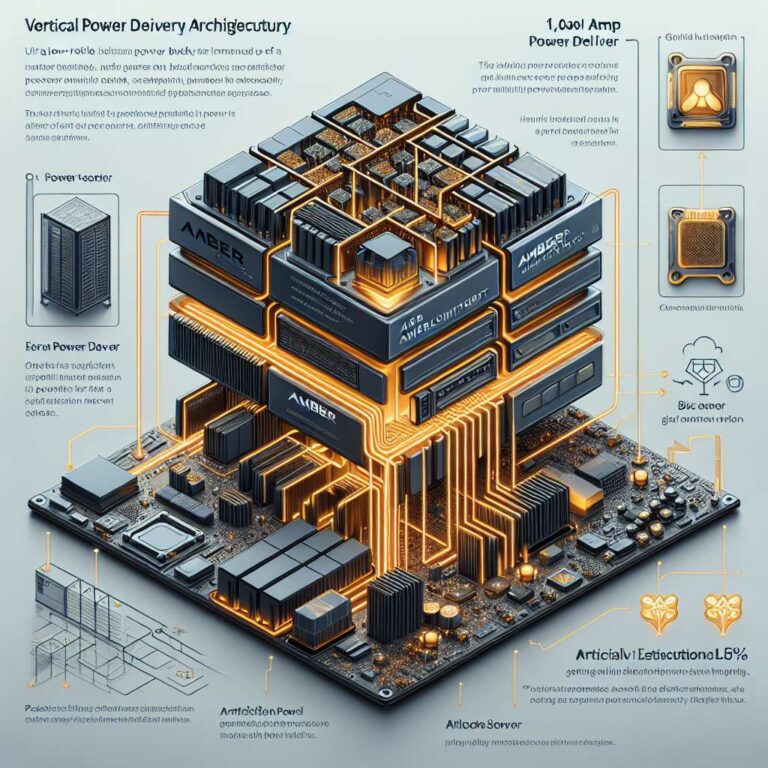
Amber Semiconductor, Inc., a fabless semiconductor company focused on next generation power management for data centers, has announced the successful tape out of its AmbersSemi Powertile vertical power delivery solution built specifically for artificial intelligence processors in data centers. The company positions Powertile as a new approach to feeding increasingly power hungry accelerators, with the device installed on the backside of a server board directly under the processor package rather than at the board periphery.

The ultra low profile Powertile is described as a 1,000 Amp vertical power device that can be mounted on the backside of a server board, directly beneath the processor. By pushing current through a short vertical path instead of across the board in a traditional lateral distribution layout, AmbersSemi states that Powertile reduces power distribution losses to the processor by more than 85%, which is intended to improve overall efficiency and make it easier to scale power delivery as artificial intelligence workloads grow.

Chief executive officer Thar Casey says the product represents a paradigm change in how power is distributed and delivered to artificial intelligence processors in data centers, arguing that existing architectures are struggling to keep up with the rising demands of next generation chips and are creating a performance limiting bottleneck. According to Casey, Powertile is designed to deliver extremely high current in a compact form factor that mounts directly beneath the processor for a shorter and more efficient power path, and the completion of this tape out is described as a critical inflection point as the company moves toward commercialization.
52

Impact Score

Nvidia launches nemotron 3 nano omni for enterprise agents

Nvidia has introduced Nemotron 3 Nano Omni, a multimodal open model designed to support enterprise agents that reason across vision, speech and language. The launch extends Nvidia’s push beyond hardware into models and services while targeting more efficient agentic workflows.

Intel 18A-P node improves performance and efficiency

Intel plans to present new results for its 18A-P process at the VLSI 2026 Symposium, highlighting gains in performance, power efficiency, and manufacturing predictability. The updated node is positioned as a stronger option for customers seeking 18A density with better operating characteristics.

EA CEO defends broader Artificial Intelligence use in game development

EA CEO Andrew Wilson defended the company’s internal use of Artificial Intelligence after employee claims that the tools were slowing work rather than helping. He framed the technology as an aid for repetitive quality assurance tasks, even as concerns persist over its broader impact on development.

Generative Artificial Intelligence is reshaping cybercrime less than feared

Research into criminal underground forums suggests generative Artificial Intelligence is being used mainly as a productivity tool rather than a transformative criminal breakthrough. The biggest near-term risks may come from automation, fraud support, and attackers adapting content to influence chatbot outputs.

Contact Us

Got questions? Use the form to contact us.

Contact Form

Clicking next sends a verification code to your email. After verifying, you can enter your message.