
ViewSonic introduces 4,000-lumen LSD400 series projectors

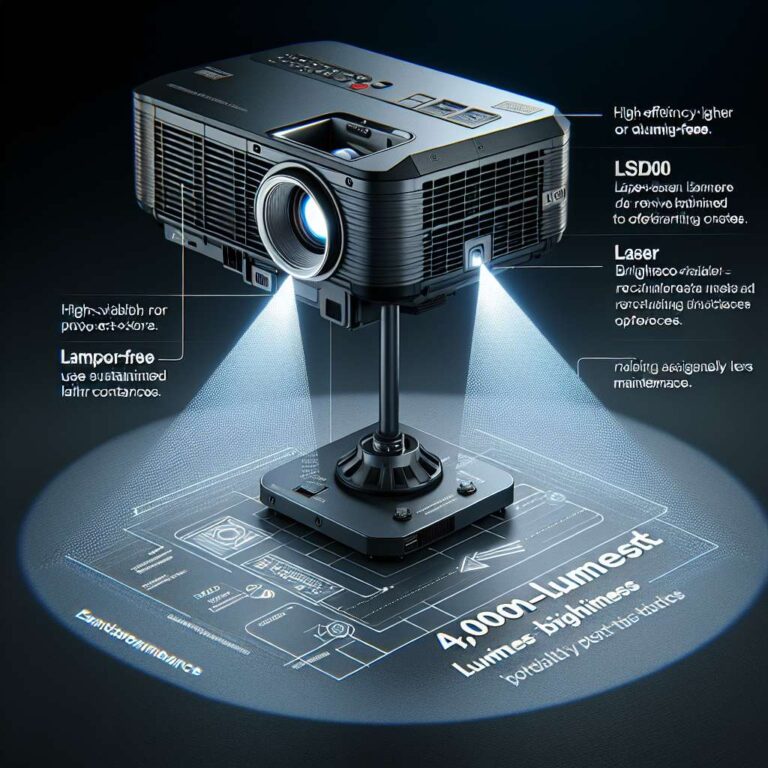
ViewSonic has unveiled the LSD400 Series, two 4,000 ANSI lumen laser projectors designed for business and education that prioritize lamp-free operation and lower power consumption.

ViewSonic corp. introduced the LSD400 Series, a pair of 4,000 ANSI lumen laser projectors that join the company´s Luminous Superior Series. The two models are the LSD400W and the short-throw LSD400HD-ST. Both models use high-efficiency laser light sources to deliver elevated brightness suited for larger rooms and installed environments. The announcement positions these units as practical and reliable options for professional deployments.

According to ViewSonic, the new projectors reduce power consumption by 49 percent compared with previous lamp-based solutions, which lowers the total cost of ownership and supports broader deployments in business and educational settings. The company highlighted lamp-free operation as a sustainability and maintenance advantage. Dean Tsai, general manager of projector and led display business unit at ViewSonic, said the company now makes up 70 percent of its lineup with lamp-free technology and noted a nine-fold sales increase in the 5,000+ ANSI lumen lamp-free segment. ViewSonic framed the LSD400 Series as combining performance and accessibility to deliver long-term value to customers.

The release emphasizes sustainable projection and lower maintenance needs as core selling points for the new models, targeting institutions that require durable, high-brightness displays. The article does not provide details on native resolution, input options, pricing, regional availability, warranty terms, or exact release dates. Those specifics are not stated in the announcement. Overall, ViewSonic presents the LSD400 Series as an energy efficient expansion of its lamp-free portfolio aimed at meeting evolving professional and educational display requirements.
65

Impact Score

Indiana launches Artificial Intelligence business portal

Indiana is rolling out IN AI, a statewide portal meant to help employers adopt Artificial Intelligence with practical guidance, workshops and peer support. State leaders and business groups are positioning the effort as a way to raise productivity, wages and job growth while keeping workers at the center.

Goodfire launches model debugging tool for large language models

Goodfire has introduced Silico, a mechanistic interpretability platform designed to let developers inspect and adjust model behavior during development. The company is positioning it as a way to give smaller teams deeper control over open-source models and more trustworthy outputs.

Nvidia launches nemotron 3 nano omni for enterprise agents

Nvidia has introduced Nemotron 3 Nano Omni, a multimodal open model designed to support enterprise agents that reason across vision, speech and language. The launch extends Nvidia’s push beyond hardware into models and services while targeting more efficient agentic workflows.

Intel 18A-P node improves performance and efficiency

Intel plans to present new results for its 18A-P process at the VLSI 2026 Symposium, highlighting gains in performance, power efficiency, and manufacturing predictability. The updated node is positioned as a stronger option for customers seeking 18A density with better operating characteristics.

EA CEO defends broader Artificial Intelligence use in game development

EA CEO Andrew Wilson defended the company’s internal use of Artificial Intelligence after employee claims that the tools were slowing work rather than helping. He framed the technology as an aid for repetitive quality assurance tasks, even as concerns persist over its broader impact on development.

Contact Us

Got questions? Use the form to contact us.

Contact Form

Clicking next sends a verification code to your email. After verifying, you can enter your message.