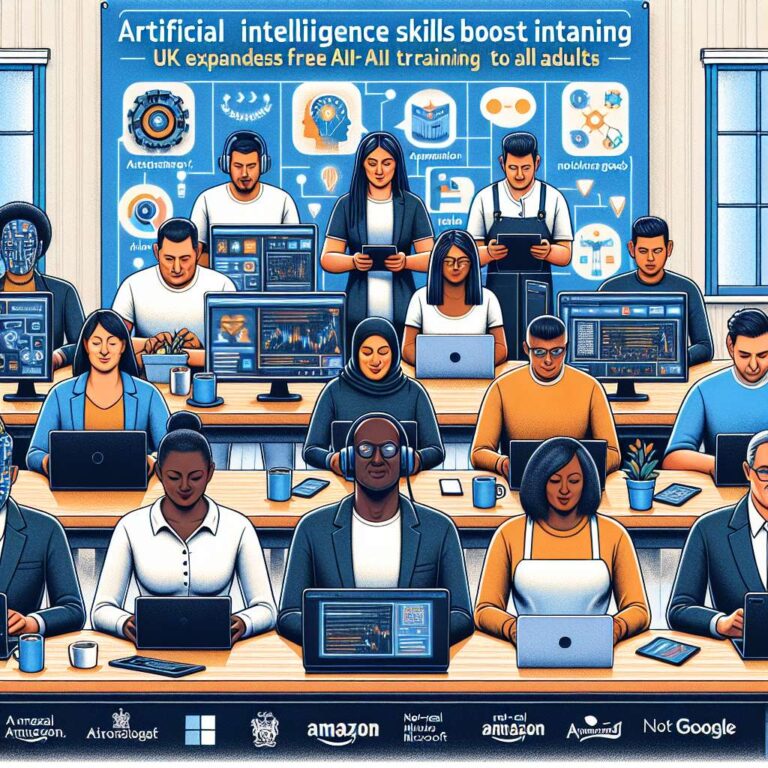
The UK government has launched a nationwide expansion of its artificial intelligence skills programme, making free artificial intelligence training available to all UK adults through the Artificial Intelligence Skills Boost initiative. Led by the Department for Science, Innovation and Technology with Skills England, the programme is framed as a response to concerns about workforce readiness as artificial intelligence tools spread across workplaces. It builds on a commitment made in June 2025 to train 7.5 million workers in artificial intelligence related skills and raises the target to 10 million people by 2030, a figure described as nearly a third of the UK workforce and as the largest targeted training effort since the creation of the Open University.
Access to the training is through the government’s Artificial Intelligence Skills Hub, a free online platform where any adult can create a profile and follow structured learning journeys alongside existing work or caring responsibilities. Courses range from short modules taking under 20 minutes to several hours in length, and participation is voluntary with learners free to choose content based on role, interests or confidence with digital tools. The curriculum focuses on practical workplace use of artificial intelligence rather than technical system development, including how to write prompts for generative tools, use artificial intelligence to draft text and content, automate routine administration and read simple artificial intelligence dashboards. All approved courses are mapped to Skills England’s artificial intelligence foundation skills for work benchmark, and completion earns a government-backed virtual Artificial Intelligence foundations badge for use on CVs and professional profiles.
The initiative is designed to tackle patchy adoption and low confidence, with research cited showing that only 21 per cent of UK workers currently feel confident using artificial intelligence in their jobs and business data indicating that as of mid-2025 only around one in six UK businesses were using artificial intelligence at all, with even lower uptake among small and micro firms. Government analysis estimates that wider use of artificial intelligence could unlock up to £140 billion in additional annual economic output by shifting time from routine tasks to higher value work. The programme is underpinned by a broad coalition of partners including Accenture, Amazon, Google, IBM, Microsoft, Salesforce, Sage, SAS, the NHS, business groups and local government bodies, which are developing courses and driving uptake, while a new Artificial Intelligence and the Future of Work Unit will track labour market impacts. Alongside the core training, the government is investing £27 million in a TechLocal scheme within a wider £187 million TechFirst programme and launching the Spärck Artificial Intelligence Scholarship for up to 100 master’s students, although critics argue that short, tool-focused modules alone cannot deliver the deeper judgement, leadership and organisational change needed for long-term adaptation.