
TSMC’s advanced packaging reportedly at max capacity as Artificial Intelligence demand grows

UDN Money reports TSMC's 'entire CoWoS series of advanced packaging products' is fully booked amid rising demand from Artificial Intelligence hardware players, prompting talks of third-party outsourcing and a possible conversion of the planned P6 fab in Arizona.

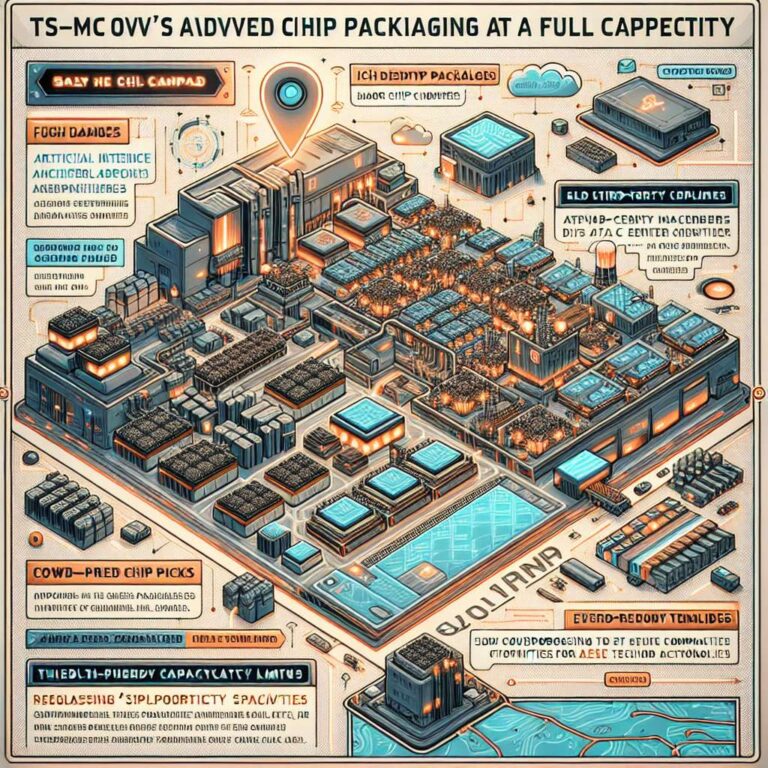
Over the past weekend, Taiwanese industry moles told UDN Money that TSMC’s ‘entire CoWoS series of advanced packaging products’ is fully booked, driven by orders reportedly from NVIDIA, Google, Amazon, and MediaTek. The report highlights various flavors of Chip-on-Wafer-on-Substrate, including CoWoS-L and CoWoS-S processes, and says a surge in requests has prompted TSMC to rethink plans beyond expansions of first-party facilities, which the company has primarily targeted at CoWoS-L. To meet what are described as lofty VIP client requests, company leadership is reportedly considering stronger ties with third-party chip packagers to handle overflow demand.

UDN Money cites Counterpoint research, which predicts that ASE Technology (in 2026) will benefit greatly from taking on some of TSMC’s ‘spillover.’ Insiders and trackers quoted in the coverage describe the situation as a temporary capacity crunch that TSMC expects to ease within the next year as supply-demand dynamics adjust. The narrative also notes competitive pressure from Intel’s emerging capabilities and rumors that Apple and Qualcomm are evaluating Team Blue’s advanced packaging processes as alternative or complementary sources, a development that could influence customer decisions.

Locally, TSMC’s Arizona hub is called out for a major shortfall: a complete lack of on-site advanced packaging. Sources say company leaders are looking into the repurposing of a planned sixth phase fabrication plant (P6 fab), which could pave the way for a ‘fast track’ deployment of US-based CoWoS activities. The combination of planned first-party expansions, potential third-party partnerships, and a possible P6 pivot frames TSMC’s current response as a mix of internal scaling and external outsourcing aimed at keeping major Artificial Intelligence hardware customers supplied while the broader supply-demand balance normalizes.
55

Impact Score

Microsoft previews Shader Model 6.10 for gpu Artificial Intelligence engines

Microsoft has introduced Shader Model 6.10 in AgilitySDK 1.720-preview with a new matrix API designed to unify access to dedicated gpu Artificial Intelligence hardware from AMD, Intel, and NVIDIA. The change is aimed at making neural rendering features easier to deploy across multiple vendors with a single programming model.

Europe’s Artificial Intelligence challenge is structural dependence

Europe has talent, research strength, and rising investment in Artificial Intelligence, but startups remain reliant on American infrastructure, platforms, and late-stage capital. The argument centers on digital sovereignty, interoperability, and ownership as the conditions for building durable European champions.

Community backlash slows Artificial Intelligence data center expansion

Political resistance, regulatory scrutiny, and rising energy and water concerns are complicating the build-out of large Artificial Intelligence data centers across the United States. The pressure is increasing costs, delaying projects, and adding fresh risks to the economics behind Generative Artificial Intelligence infrastructure.

House panel advances export controls after China report

The House Foreign Affairs Committee moved export control legislation after a House Select Committee report detailed China’s use of illegal means to build its Artificial Intelligence and semiconductor sectors. The measure is aimed at chip smuggling and Artificial Intelligence model theft.

Contact Us

Got questions? Use the form to contact us.

Contact Form

Clicking next sends a verification code to your email. After verifying, you can enter your message.