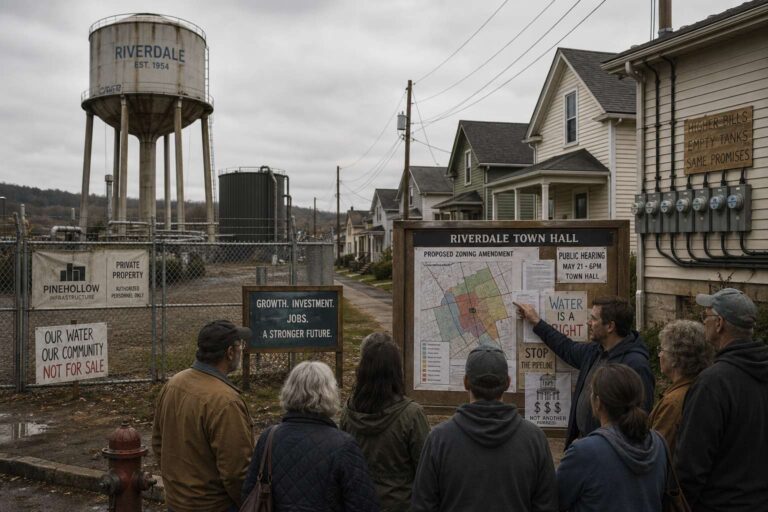
Large data centers built for Artificial Intelligence workloads are facing mounting opposition across the United States as communities object to their power use, water consumption, environmental impact, and effect on household utility bills. The report argues that these facilities have shifted from low-profile industrial sites to highly visible projects that strain local resources and trigger organized resistance. A single hyperscaler one-gigawatt (GW) facility can consume enough water to fill up to 24 Olympic-size pools a day and draw enough electricity to power 2,200 homes for an entire year. Between January 2025 and February 2026, at least 78 proposed data centers faced major roadblocks, and more than 40% of these projects were withdrawn by developers while the rest remained stalled.
Power availability has emerged as a central constraint. Experts project data centers’ electricity consumption will double from 6% to 12% of total usage by 2028, while developers have announced projects requiring an additional 105GW of power. In the PJM region, household bills are up as much as 20% in some states, and capacity auction clearing prices rose from around ?/MW-day in 2024-2025 to ?/MW-day in the auction for power to be delivered in 2026-2027. Households in PJM’s region will foot an extra ?.1B in costs tied to existing and planned data center demand. Some states are responding by allowing regulators to curtail hyperscale facilities during peak demand, which could force operators onto diesel backup systems just as fuel costs are rising. Since late February 2026, US diesel prices have surged by roughly 33%, climbing above ? per gallon, with fuel typically accounting for 70% to 90% of diesel generation costs.
Water use and local trust have become another major flashpoint. Residents in stressed regions have raised alarms about dry wells, discolored water, and limited public disclosure from developers and officials. New cooling technologies can reduce water use by up to 70%, but public perception remains deeply negative. Microsoft responded in January 2026 with a “Community First AI Infrastructure” initiative that pledged to pay higher electricity rates, use less water, and forgo property tax breaks on new data centers. At the same time, criticism is growing over subsidies offered in 36 states and over job promises that can shrink to under one hundred permanent roles once construction ends. A 2025 Pew Research survey showed 50% of Americans are more concerned than excited about the growing use of Artificial Intelligence in daily life, up from 37% in 2021.
That backlash is increasingly shaping politics and regulation. At least 271 local governments have reviewed zoning rules since June 2024, and lawmakers introduced more than 200 bills in 2025 targeting data center operations. In 2026, over 30 states have introduced 300 bills in just the first two months. Maine is considering legislation to freeze major data center construction until 2027, potentially becoming the first statewide ban in the US. Financial risks are also spreading. In December 2025, reports of Oracle delaying OpenAI data centers contributed to the cancellation of a ?B, 1GW data center project in Michigan by Blue Owl Capital. JPMorgan estimates data-center related entities will need to issue up to ?B in debt by 2027, while hyperscalers alone are expected to spend ?B in capital expenditures in 2026.