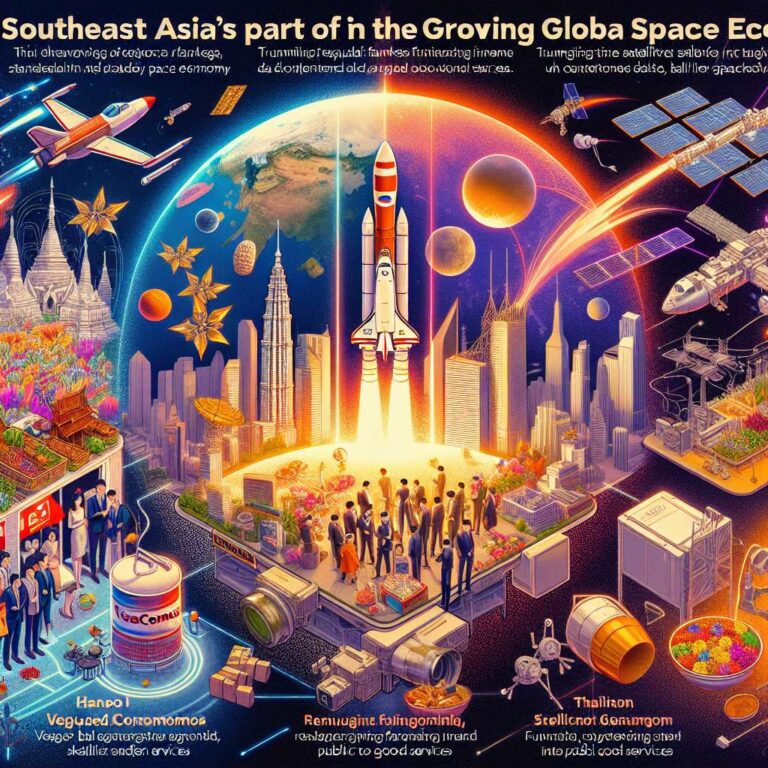
At the Thai Space Expo in Bangkok, held in one of the city’s busiest shopping malls, the mix of flashy space suits, model rockets, and a plain-looking package of Thai basil chicken underscored how Southeast Asia is trying to stake out a place in the global space sector. The chicken, a vacuum sealed pad krapow meal produced by Charoen Pokphand Foods, the biggest food company in Thailand, was highlighted as the same kind of package that had just been launched to the International Space Station, turning an everyday street food staple into a symbol of national ambition in orbit.
The expo brought together enthusiastic attendees and companies from emerging space nations including Vietnam, Malaysia, Singapore, and Thailand to showcase Southeast Asia’s fledgling space industry. Candace Johnson, a partner at Seraphim Space, a United Kingdom investment firm operating in Singapore, argued that “Southeast Asia is perfectly positioned to take leadership as a space hub,” pointing to what she described as “a lot of opportunities.” On the sidelines of the event, Thailand’s Geo Informatics and Space Technology Development Agency revealed that the country may build a spaceport to launch rockets in the next few years, with acting space economy advancement division head Atipat Wattanuntachai noting that there is currently no spaceport in Southeast Asia and citing Thailand’s proximity to the equator as a potential advantage.
Across the region, companies are probing how to plug into the global space economy, from VegaCosmos in Hanoi looking to apply satellite data to urban planning, to the Electricity Generating Authority of Thailand using space based monitoring of rainstorms to predict landslides, to Seoul based startup Spacemap building satellite tracking tools backed by the United States Space Force. The pad krapow stunt, delivered to the International Space Station on a private mission operated by United States based Axiom Space and now marketed by Charoen Pokphand as chicken fit for NASA, encapsulated the blend of tradition and modernity that runs through Bangkok and its space aspirations. Johnson suggested that Southeast Asia’s manufacturing strengths could feed into satellite semiconductor production or even in space manufacturing, hinting at broader industrial roles the region might play as it seeks a foothold in space.