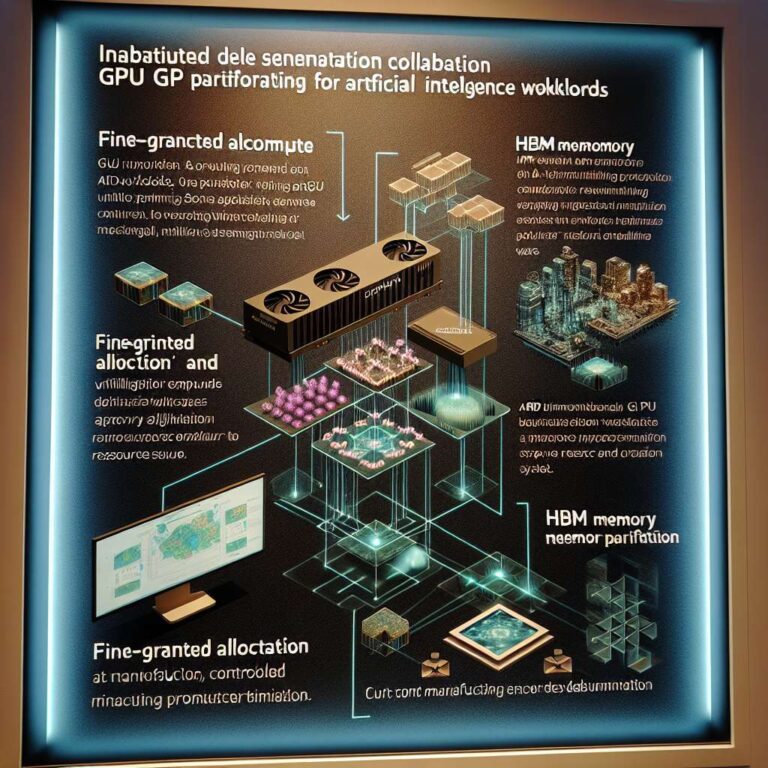
SoftBank and AMD have begun joint validation of AMD Instinct GPUs for next generation artificial intelligence infrastructure, centered on a GPU partitioning mechanism that lets a single GPU handle multiple artificial intelligence workloads simultaneously. SoftBank created an Orchestrator system that divides AMD Instinct GPU resources according to workload requirements such as model size, number of concurrent executions, and memory needs. The system splits compute workloads across multiple GPU instances running on individual Accelerator Complex Dies, with configurations ranging from single instance mode, called SPX mode, up to eight instances, called CPX mode, which is intended to align GPU utilization with heterogeneous demand.
The architecture extends partitioning to memory, with HBM memory pools divided into individual regions for each GPU instance to prevent latency spikes and interference between workloads. The goal is to avoid the inefficiency of uniform GPU resource allocation, which can cause either GPU resource shortages or waste when different artificial intelligence tasks share a device. SoftBank states that the enhanced Orchestrator runs multiple artificial intelligence applications on a single GPU with minimal resource strain, and SoftBank highlights improved resource allocation for small and mid size language model workloads, although no performance figures are being disclosed yet.
SoftBank plans to explore similar orchestration techniques for other artificial intelligence accelerators beyond AMD hardware, signaling a broader strategy for multi tenant accelerator deployments. A live demonstration is scheduled at the AMD booth during MWC Barcelona 2026 in March 2-5, and SoftBank has published technical details on the architecture and Orchestrator management methods on its Research Institute of Advanced Technology blog. In parallel, AMD’s next generation Instinct MI455X accelerators, which are positioned to compete with NVIDIA’s Vera Rubin, are reportedly facing serious manufacturing problems that are pushing back AMD’s roadmap, with only limited production expected this year and mass production delayed to Q2 2027.