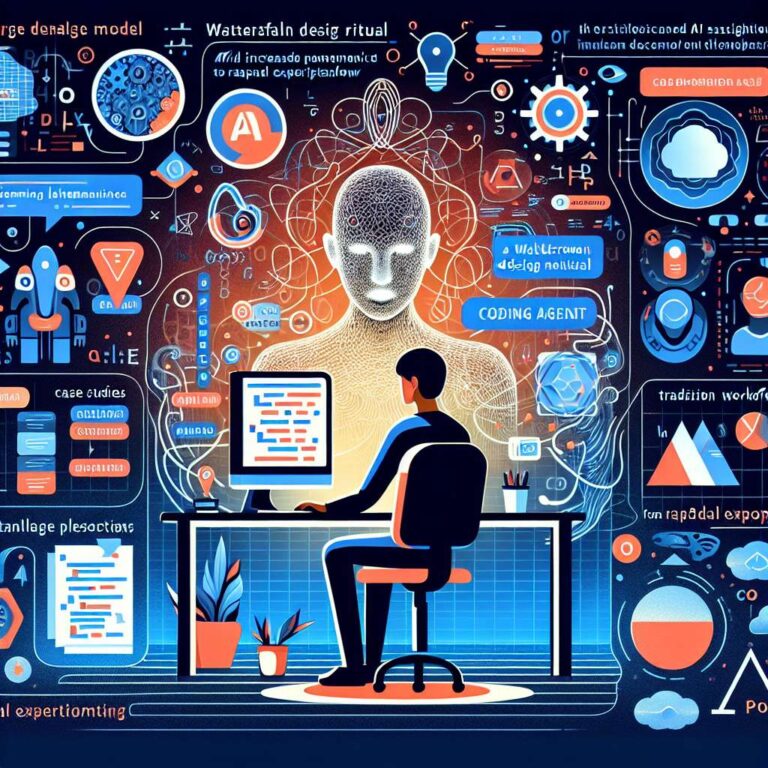
Simon Willison’s ongoing “Artificial Intelligence assisted programming” tag collects a stream of notes and case studies about how large language models and coding agents are changing everyday software development. He highlights a cultural and process shift, citing Jenny Wen’s argument that traditional design processes may be outdated when prototypes are cheap and fast to build, and connects this directly to Artificial Intelligence assisted programming lowering the cost of “wrong” implementations from potentially months of work to just a few days. Willison emphasizes that this enables more experimentation and bolder exploration of problem spaces, while acknowledging that this perspective aligns with his long-standing preference for rapid prototyping.
A major theme across the posts is the emergence of autonomous or semi-autonomous coding agents and their impact on complex software projects. Willison digs into Cursor’s FastRender browser, built by swarms of agents that wrote over 1 million lines of code across 1,000 files, and verifies that the resulting Rust-based browser can be built and run locally, complete with visible rendering quirks that confirm it is not wrapping an existing engine. He describes similar multi-agent or coding-assistant workflows in other contexts, such as Salvatore Sanfilippo’s pure C implementation for the FLUX.2-klein-4B image model, and new tools like claude-code-transcripts for understanding what coding agents did on a project. He also documents benchmarks from a “vibespiled” family of HTML5 parsers, where Rust, Swift, JavaScript, and Python implementations show sharply different total parse time figures, and he repeatedly returns to conformance tests as the backbone that makes these Artificial Intelligence driven ports and implementations viable.
Willison’s curation also explores how Artificial Intelligence assistance affects careers, learning, and developer identity. He quotes practitioners like Salvatore Sanfilippo, Kent Beck, Obie Fernandez, Jaana Dogan, Ben Werdmuller, Boris Cherny, Liz Fong-Jones, and others to illustrate a split between developers who value the craft of typing code and those who care more about design decisions and outcomes. Several posts argue that Artificial Intelligence tools are now powerful enough that ignoring them is a career risk, particularly when they let experienced engineers and even managers ship meaningful code in short sessions instead of needing 2-4 hour blocks. At the same time, Willison repeatedly stresses responsibility: he criticizes “vibe coding” that produces giant untested pull requests, insists that “your job is to deliver code you have proven to work,” and raises unresolved questions around ethics, copyright, and open source licensing when using models to port or generate libraries. The result is a nuanced, evolving snapshot of how Artificial Intelligence assistants are reshaping programming practice, tools, and norms, while still depending heavily on human judgment, testing discipline, and thoughtful orchestration.