
SiFive launches 2nd generation RISC-V intelligence family for Artificial Intelligence workloads

SiFive introduced its 2nd Generation Intelligence family of RISC-V products to accelerate Artificial Intelligence workloads across thousands of potential applications. The lineup includes two new chips for the far edge and three upgraded designs with enhanced scalar, vector and matrix processing.

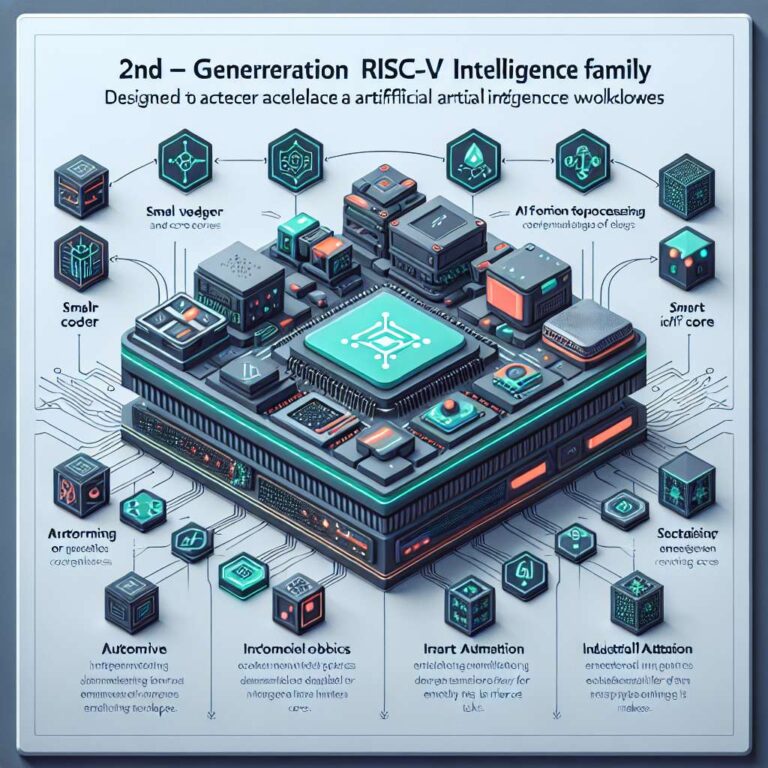
SiFive announced its 2nd Generation Intelligence family, a set of five RISC-V-based products designed to accelerate Artificial Intelligence workloads. The new lineup comprises two all-new parts, the X160 Gen 2 and X180 Gen 2, alongside upgraded X280 Gen 2, X390 Gen 2 and XM Gen 2 models. The company framed the release as an expansion of its RISC-V Artificial Intelligence IP portfolio to cover a broad set of application needs.

All members of the family include enhanced scalar and vector processing capabilities tailored to modern Artificial Intelligence workloads. The XM Gen 2 is highlighted for adding or emphasizing matrix processing capability in addition to scalar and vector units. SiFive positions these architectural elements as responses to the mixes of compute primitives used by contemporary machine learning and inference tasks, aiming to better match processing types to workload requirements.

SiFive singled out the X160 Gen 2 and X180 Gen 2 as targets for far edge compute and internet of things applications, noting their focus on high efficiency within a compact footprint. The company emphasized use in deeply embedded edge environments that are tightly constrained by power and area. Industries explicitly cited as targets include automotive, autonomous robotics, industrial automation and smart IoT. The remaining three products are presented as upgraded offerings within the same 2nd Generation family, broadening SiFive´s product range for different deployment scenarios and application scales.
65

Impact Score

CXL and HBM reshape memory competition in data centers

CXL is emerging as a complementary technology to HBM in Artificial Intelligence servers, promising larger memory pools, lower costs, and more flexible scaling. Samsung, SK Hynix, Micron, Intel, AMD, NVIDIA, and Google are all pushing the ecosystem toward broader deployment.

Artificial Intelligence agents face memory limits in wealth management

Citi is pushing deeper into Artificial Intelligence for wealth management with a new digital advisor, but industry executives say agent memory remains a major constraint. Better short-term and long-term recall could eventually help advisors serve more clients and maintain more continuous relationships.

OpenClaw pushes autonomous Artificial Intelligence agents into enterprises

OpenClaw’s rapid growth is accelerating interest in persistent, self-hosted autonomous agents that run continuously instead of waiting for prompts. NVIDIA is positioning NemoClaw as a more secure reference implementation for organizations that want local control, auditability and hardened deployment defaults.

Indiana launches Artificial Intelligence business portal

Indiana is rolling out IN AI, a statewide portal meant to help employers adopt Artificial Intelligence with practical guidance, workshops and peer support. State leaders and business groups are positioning the effort as a way to raise productivity, wages and job growth while keeping workers at the center.

Contact Us

Got questions? Use the form to contact us.

Contact Form

Clicking next sends a verification code to your email. After verifying, you can enter your message.