
Samsung reallocates NAND production to DRAM as Artificial Intelligence demand rises

Samsung plans to convert NAND capacity in its Pyeongtaek and Hwaseong campuses into DRAM production and will run Pyeongtaek Fab 4 as a DRAM-only 1c line in response to rising Artificial Intelligence-driven DRAM demand.

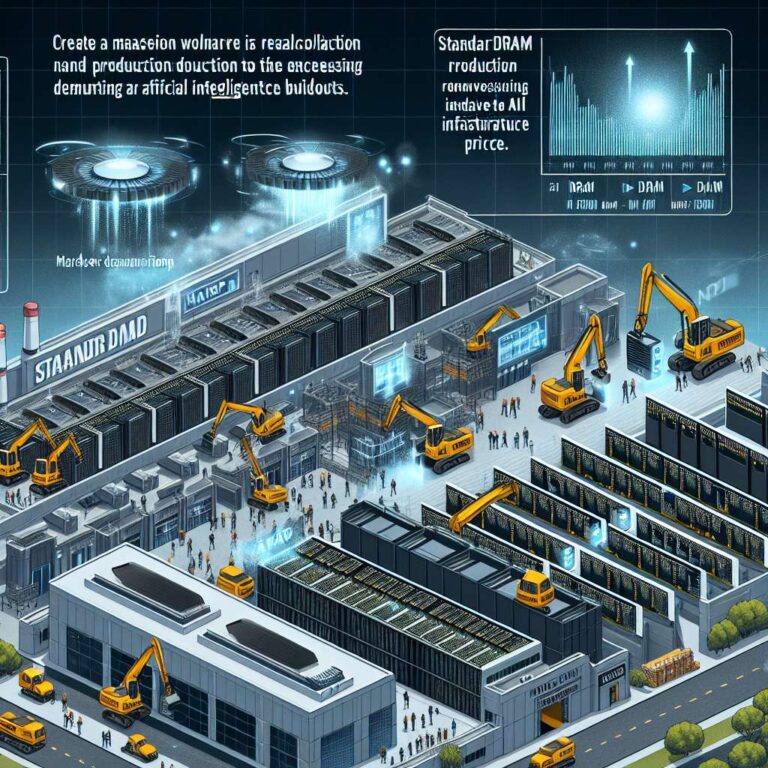
Samsung is preparing a major shift in its memory production strategy as demand for DRAM surges amid global Artificial Intelligence infrastructure growth. According to Korean industry reports cited by SE Daily, parts of NAND flash lines in Pyeongtaek and Hwaseong will be converted to DRAM production. The company will operate the upcoming Pyeongtaek Fab 4, known as P4, as a DRAM-only line using its latest 1c process.

The changes affect Samsung’s existing hybrid production footprint. Samsung currently produces both DRAM and NAND across Pyeongtaek Fab 1, Pyeongtaek Fab 3, and its Hwaseong campus. The hybrid lines at P1 and Hwaseong will shift further toward DRAM as NAND equipment is removed. Fab 4, now in final construction, is slated to start up next year as a dedicated 1c DRAM line, and Samsung is also considering using a second zone of P4, originally planned for foundry production, for DRAM as well.

Market conditions are driving the reallocation. Industry sources say Samsung has become cautious about the NAND market while demand for standard DRAM has jumped sharply and prices are rising fast. Some server customers are reportedly offering as much as 70% higher prices for 96 GB and 128 GB DDR5 modules yet still cannot secure adequate supply. Big tech firms reportedly expect shortages to run for years and are already negotiating DRAM allocations for 2027.

Once the shifts are implemented, Samsung’s DRAM output from P1 (Hwaseong) and Fab 4 (P4) is expected to climb significantly in the first half of next year. The company will reportedly offset reduced Korean NAND production with higher output from its Xi’an plant in China, reallocating capacity to align production with current demand patterns in the memory market.
65

Impact Score

Siemens debuts digital twin composer for industrial metaverse deployments

Siemens has introduced digital twin composer, a software tool that builds industrial metaverse environments at scale by merging comprehensive digital twins with real-time physical data, enabling faster virtual decision making. Early deployments with PepsiCo report higher throughput, shorter design cycles and reduced capital expenditure through physics-accurate simulations and artificial intelligence driven optimization.

Cadence builds chiplet partner ecosystem for physical artificial intelligence and data center designs

Cadence has introduced a Chiplet Spec-to-Packaged Parts ecosystem aimed at simplifying chiplet design for physical artificial intelligence, data center and high performance computing workloads, backed by a roster of intellectual property and foundry partners. The program centers on a physical artificial intelligence chiplet platform and framework that integrates prevalidated components to cut risk and speed commercial deployment.

Patch notes detail split compute and IO tiles in Intel Diamond Rapids Xeon 7

Linux kernel patch notes reveal that Intel’s upcoming Diamond Rapids Xeon 7 server processors separate compute and IO tiles and adopt new performance monitoring and PCIe 6.0 support. The changes point to a more modular architecture and a streamlined product stack focused on 16-channel memory configurations.

Contact Us

Got questions? Use the form to contact us.

Contact Form

Clicking next sends a verification code to your email. After verifying, you can enter your message.