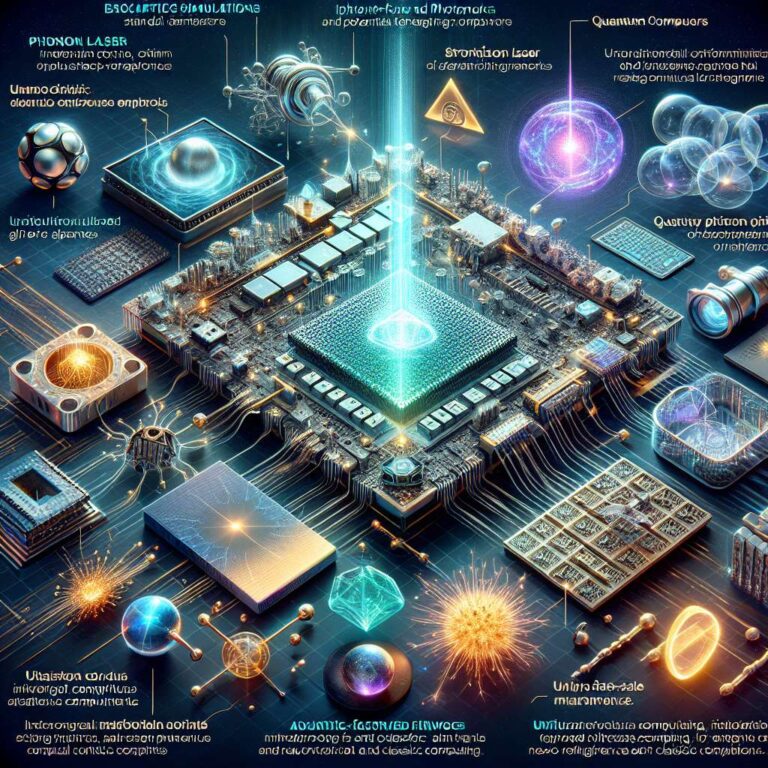
The ScienceDaily computer science page aggregates a wide range of recent developments across computing, quantum technologies, and Artificial Intelligence hardware. The feed opens with top headlines like simulations of self interacting dark matter, a newly demonstrated “phonon laser” that generates tiny vibrations on a microchip, and microscopic robots that can sense, decide, and move autonomously while being powered by light. Other leading items include chip based quantum memory using 3D printed light cages, microchip sized devices that stabilize laser frequencies for quantum computing, and confirmation that ultrathin ruthenium dioxide is an altermagnet material with distinctive magnetic properties relevant to future Artificial Intelligence hardware.
Further down, the “Latest Headlines” section focuses on quantum computing and photonics. Articles describe how quantum computers may have serious security flaws, new ways to clean up stray photons in quantum systems, and techniques for validating quantum computer results for complex devices. There is coverage of scalable quantum circuits running on more than 100 qubits, a tantalum silicon qubit from Princeton with coherence beyond a millisecond, and rare earth crystals that extend quantum communication distances by a factor of 200x. The list also highlights an extraordinary crystal, strontium titanate, that improves its performance near absolute zero, along with stories of electrons entering unusual quantum states and quantum simulations that now run on laptops instead of supercomputers.
A separate “Earlier Headlines” block surveys a broader mix of experimental platforms and architectures. There are reports of artificial neurons based on ion driven memristors, an optical feature extraction engine that operates at 12.5 GHz using light, and living computers built from trained shiitake mushrooms acting as organic memory. Other articles cover wireless eye implants for restoring vision, quantum crystals for future computing, frequency comb “rainbow” chips for communications, silicon quantum chips produced in foundries with over 99% fidelity, and Caltech’s 6,100 neutral atom qubit array. Additional headlines detail micromotors smaller than a human hair, efforts to replace silicon with 2D materials, glass fiber based Artificial Intelligence at light speed, photonic quantum chips that make Artificial Intelligence more efficient, and a suite of neuromorphic, thermal management, and spintronics advances. The page closes with navigation across topic areas, emphasizing that these stories sit within the broader “computers and math” and “Artificial Intelligence” coverage.