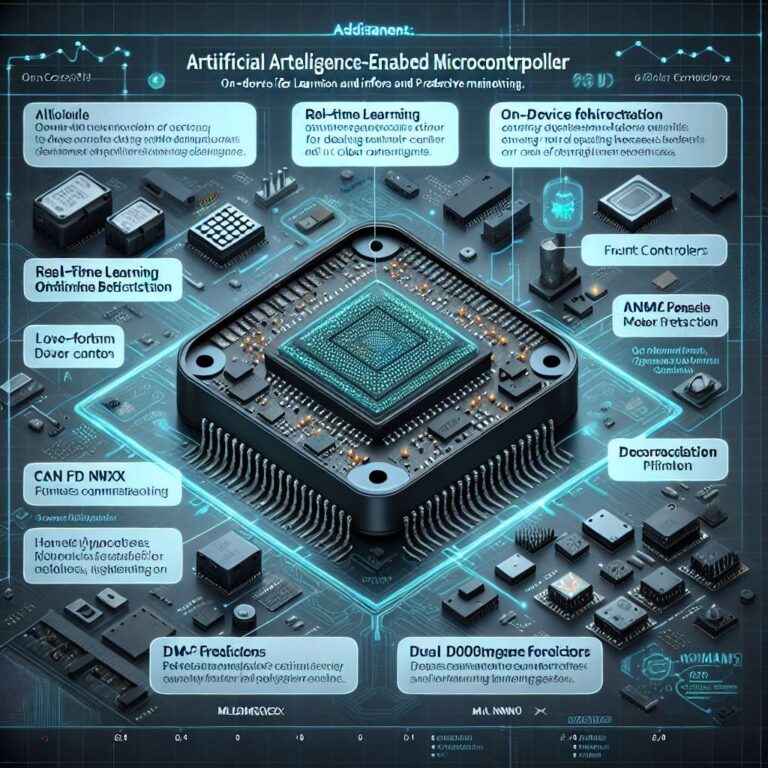
ROHM Semiconductor has announced the launch of its new Artificial Intelligence-equipped microcontroller units (AI MCUs), marking a significant advancement in edge computing for industrial and consumer devices. The ML63Q253x-NNNxx and ML63Q255x-NNNxx microcontrollers are the first in the industry to provide on-device learning and inference for fault prediction and degradation forecasting without depending on network connectivity. Designed for applications such as factory automation, motor control, residential facilities, and home appliances, these MCUs utilize sensor data to deliver real-time equipment monitoring and predictive maintenance, addressing the industry´s increasing demand for resilient and cost-effective system management.
Standard Artificial Intelligence models often rely on cloud access and high-performance CPUs, leading to added complexity, higher costs, and potential security vulnerabilities. ROHM´s innovation overcomes these challenges by enabling both learning and inference directly on the device through its proprietary Solist-AI™ solution, built upon a streamlined three-layer neural network. The AI accelerator, AxlCORE-ODL, allows these MCUs to perform Artificial Intelligence operations up to 1,000 times faster than conventional software-based MCUs, ensuring immediate detection and output of anomalous conditions. This architecture supports flexible adaptation across different installation scenarios and allows efficient retrofitting of existing systems to enhance uptime and reduce operating costs.
The new MCUs are based on a 32-bit Arm Cortex-M0+ core and integrate hardware features like CAN FD controllers, 3-phase motor control PWM, and dual A/D converters, all while consuming approximately 40mW. Sixteen product variations are offered, catering to diverse memory, package, and interface requirements, with mass production already underway for select models. To aid design and deployment, ROHM provides an ecosystem that includes simulation tools, evaluation boards, and partnerships for comprehensive support throughout development. Use cases extend from FA sensors and motors to batteries, robots, and home appliances, delivering high-precision anomaly detection and condition-based monitoring by pairing with various sensors. Solist-AI™ Sim and other development resources are available online, further simplifying integration for manufacturers aiming to leverage advanced, standalone Artificial Intelligence on the edge.