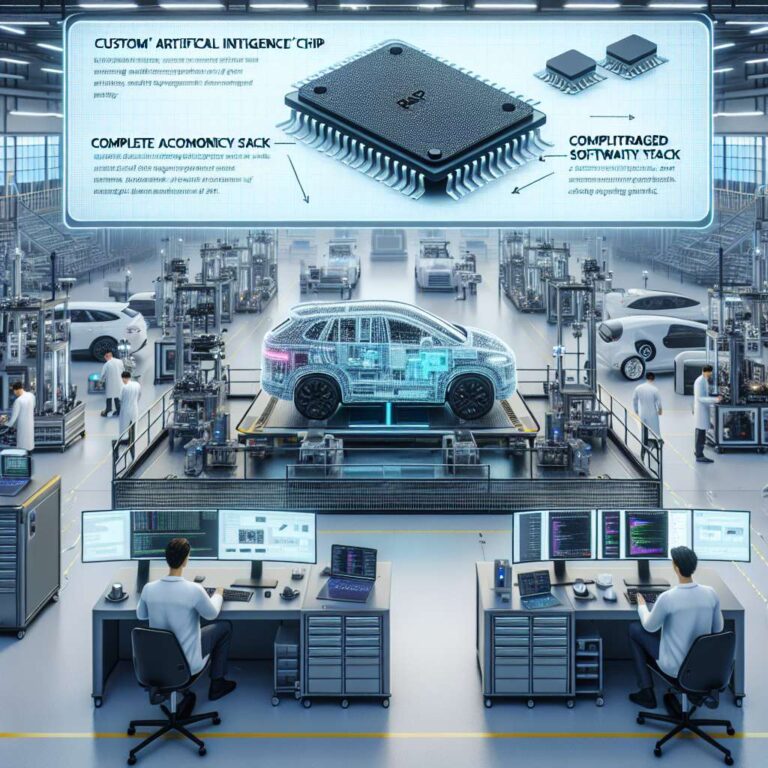
Rivian Automotive has introduced a custom artificial intelligence chip and a full autonomy platform designed and engineered in-house, signaling a shift away from third-party computing solutions such as Nvidia processors. The announcement came during the company’s first “Autonomy & AI Day” in Palo Alto, California, where Rivian said that its new silicon and software architecture will power next-generation driver assistance and automated capabilities, beginning with its upcoming R2 vehicle line and extending to future vehicles. The company framed the move as part of a broader push in the electric vehicle market toward vertical integration of core technologies, especially as autonomous driving becomes central to product differentiation.
At the heart of the new stack is the Rivian Autonomy Processor (RAP1), a custom, purpose-built chip fabricated by Taiwan Semiconductor Manufacturing Co. (TSMC) and described as optimized for vision-centric artificial intelligence tasks. Rivian said RAP1 powers its third-generation compute architecture, the Autonomy Compute Module 3 (ACM3), which it expects to ship on production vehicles starting with the R2 in late 2026. The company also said it plans to use lidar sensors alongside cameras and radar in future vehicles as part of a multimodal sensor strategy aimed at improving object detection and redundancy. To support these hardware upgrades, Rivian introduced new autonomy software based on a foundational “Large Driving Model,” a neural network trained on real and simulated driving data that it intends to integrate across future vehicles to enhance perception and planning.
Rivian’s strategy represents a deliberate move away from general purpose chips from Nvidia that are designed for many customers and use cases, which the company suggests can limit long-term customization and slow feature development. Reports cited by the company noted that Rivian plans to replace Nvidia processors used in earlier autonomy systems with its own silicon in future vehicles, and that leadership views autonomy as an end-to-end effort that requires compute, sensors, models and software to be developed together. Rivian also launched a subscription service, Autonomy+, which it said is priced at $2,500 upfront or $49.99 per month and is significantly below some rival offerings, with universal hands-free driver assistance projected to work on more than 3.5 million miles of mapped roads in the U.S. and Canada. Drawing parallels to Tesla, Chinese automakers and Apple’s shift to custom silicon, Rivian characterized its compute platform as strategic intellectual property and said vehicles equipped with its custom autonomy hardware and software are expected to begin production in late 2026, followed by ongoing software updates for both hands-free and higher-level autonomous features.