The article argues that quantum technologies have become foundational for economic competitiveness, national security and scientific leadership in the 21st century, and that sustained United States leadership in quantum information science depends on reauthorizing the National Quantum Initiative. The original bipartisan law, signed on Dec. 21, 2018, created a broad, multi-agency strategy across universities, national laboratories and industry that accelerated progress in qubit coherence, gate fidelities and system scaling. That coordinated effort is described as having moved quantum platforms from isolated demonstrations toward scalable architectures and clarified a realistic roadmap for useful quantum systems, reinforcing the value of long-term, national-level investment.
The piece highlights testimony by under secretary for science Dr. Darío Gil, who framed the current moment as a scientific revolution driven by the convergence of Artificial Intelligence, high-performance computing and quantum systems. He outlined a “Genesis Mission” to mobilize laboratories, industry and academia to build an integrated discovery platform capable of doubling the nation’s R&D productivity within a decade, and emphasized that Artificial Intelligence and quantum computing together now form the basis of a new class of supercomputers. The article stresses that realizing this vision requires breaking down silos and explicitly integrating Artificial Intelligence and quantum technologies, since many of the most consequential quantum applications will be embedded in Artificial Intelligence-driven workflows. It contends the existing national strategy predates this understanding, so a renewed National Quantum Initiative must explicitly support integration of Artificial Intelligence, accelerated computing and quantum processors.
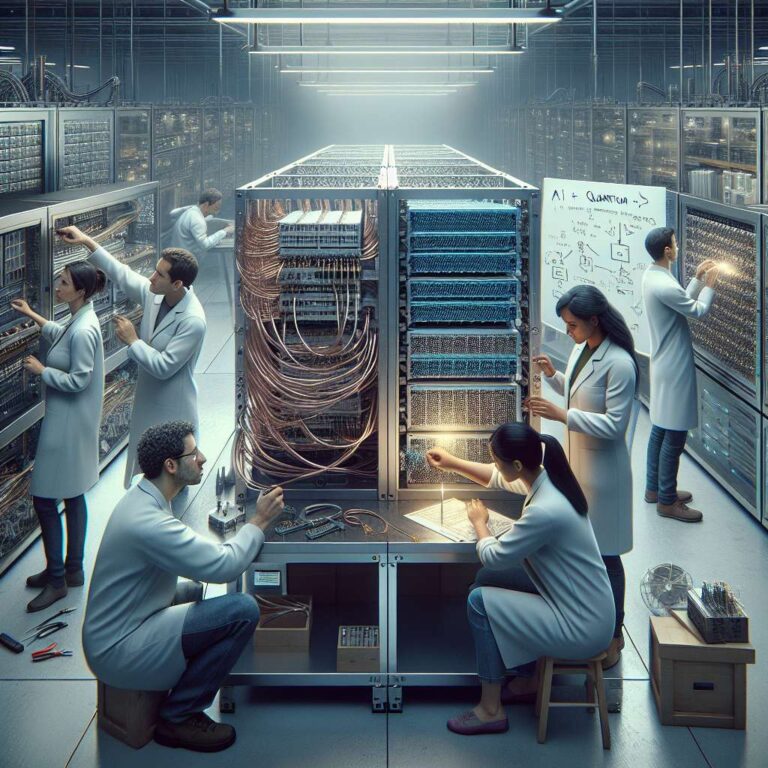
The authors describe a mission-focused approach centered on quantum-GPU supercomputers, in which GPUs, CPUs and quantum processing units are unified into a single system that can deliver hundreds of logical qubits and millions of operations as a practical scientific resource. They point to NVIDIA’s NVQLink “Bridge” interconnect and CUDA-Q software platform as examples of open architectures enabling tight coupling of classical and quantum resources, while noting that Artificial Intelligence is now central to tasks such as quantum error correction, hardware calibration and algorithm discovery. Because industry alone cannot deploy massive, fault-tolerant infrastructures, the article calls for a strong federal role, including national testbeds and open validations, and ties this to existing agency goals such as the United States Department of Energy’s target to deploy a scientifically useful quantum supercomputer in the U.S. by 2028.
Looking ahead, the authors propose specific priorities for a reauthorized National Quantum Initiative to evolve from a discovery focus into integrated system-level deployment. They recommend funding “quantum digital twins” through advanced electronic design automation to simulate quantum hardware before fabrication, and ensuring sufficient research and Artificial Intelligence infrastructure to build large-scale systems of logical qubits through quantum error correction. The article also calls for deeper Artificial Intelligence integration by supporting quantum-simulated datasets and creating an “AI+Quantum” hub, launching flagship hybrid applications in chemistry, materials science and life sciences, and empowering organizations such as the QED-C to lead benchmarking and standards work so “scientifically useful” systems are rigorously defined. It concludes that integrating Artificial Intelligence and quantum computing will underwrite this century’s economic and security leadership, and that reauthorizing the National Quantum Initiative is essential for the United States to convert its strengths in research and Artificial Intelligence into lasting strategic advantage.