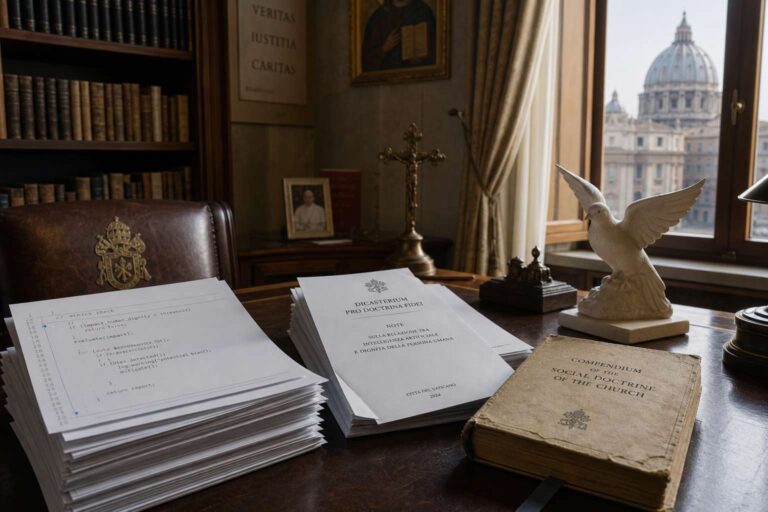
Pope Leo XIV has created a study group on Artificial Intelligence as the Vatican prepares to release his first encyclical. The initiative reflects his concern about the rapid spread of the technology and its consequences for human beings and humanity as a whole. The encyclical is expected to argue for an ethics-based approach to Artificial Intelligence that places human dignity and peace at the center of development and use.
The announcement came a day after Leo signed the encyclical, 135 years to the day after Pope Leo XIII dated “Rerum Novarum,” a foundational text of modern Catholic social thought. Leo has linked the current Artificial Intelligence revolution to the social upheaval of the Industrial Revolution, suggesting the church should again address questions involving labor, justice, and the obligations of institutions toward people. Vatican officials said the new study group was created because of the acceleration in Artificial Intelligence use and the church’s concern for the dignity of every human being.
The Vatican is positioning itself as a moral voice in a global debate increasingly shaped by governments and technology companies. The public release of the encyclical, expected in the coming weeks, could sharpen differences with the Trump administration, which views rapid Artificial Intelligence development as central to economic and security policy and has resisted international regulatory efforts. The Vatican, by contrast, has supported stronger ethical guardrails and has previously issued guidance on the use of Artificial Intelligence in warfare, education, and healthcare.
That broader effort builds on years of Vatican engagement. In 2020, the Vatican enlisted tech companies to sign on to an Artificial Intelligence pledge, the Rome Call for Artificial Intelligence Ethics, which promoted inclusiveness, accountability, impartiality, and privacy. Pope Francis later called for an international treaty to regulate Artificial Intelligence and in 2024 urged political leaders to ensure that decisions about weapons remain under human control, ultimately advocating a ban on lethal autonomous weapons.
Leo has carried those concerns forward while adding his own emphasis on truth, peace, and human relationships. He has warned priests not to use Artificial Intelligence to write homilies and has voiced concern about generative systems that can deceive through deepfake imagery. In a June 2025 speech to an Artificial Intelligence conference, he praised contributions to healthcare and scientific discovery while questioning the effects on humanity’s openness to truth and beauty. He has also called for close scrutiny of Artificial Intelligence in warfare, citing conflicts in Ukraine, Gaza and the Palestinian territories, Lebanon, and Iran as evidence of a dangerous fusion between war and new technologies.