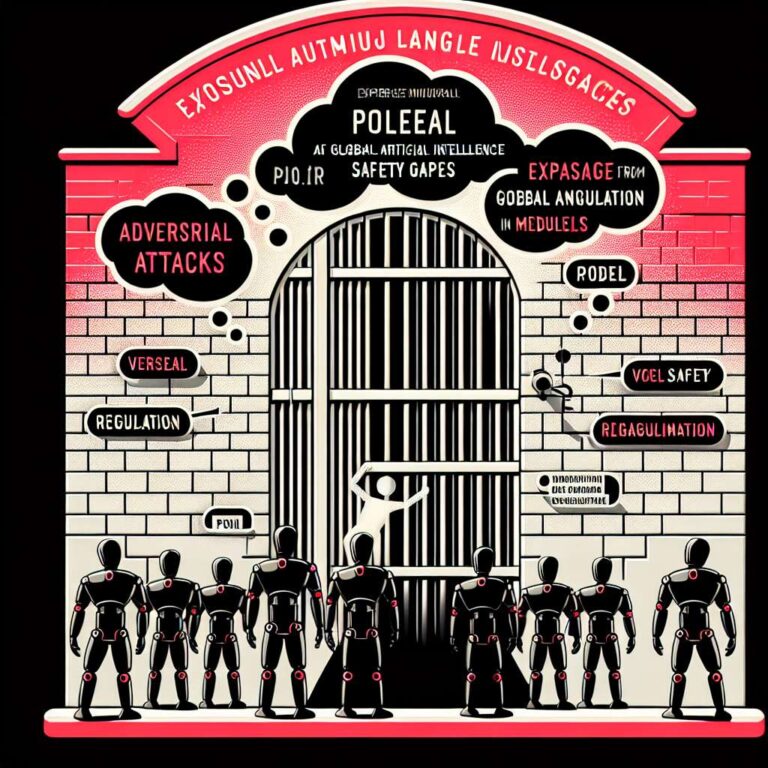
The article details new research on poetic jailbreak attacks that exploit structural weaknesses in large language model safeguards. Hand-crafted poems bypassed filters in 62 percent of trials across leading models, and automated verse still broke guards nearly half the time, without needing multi-turn manipulation. Researchers describe how Adversarial Poetry amplifies attack reach twelvefold for several risk categories, with models from Google, Meta, and multiple startups showing similar vulnerabilities while only certain OpenAI variants resisted most single-turn poems. The study positions poetic jailbreaks as a universal threat path that low-skill attackers can replicate, prompting calls for more rigorous large language model safety standards and certification pathways.
Granular statistics from the preprint cover 1,200 transformed prompts and focus on Attack Success Rate, or ASR, as a benchmark for harmful request completion. 13 of 25 models scored above 70% ASR on crafted poems and Google Gemini 2.5 Pro recorded 100% ASR, worst case, while OpenAI GPT-5 variants held between 0% and 10% ASR. CBRN prompts saw up to 18× higher success in verse form and, in contrast, prose versions rarely breached 10 percent ASR, showing that style rather than substance defeated many token-based heuristics. Verse based prompts enabled rapid Malware Creation tutorials previously blocked, exposing weaknesses in filters tuned for literal phrasing and banned keywords. The authors argue that poetic prompts exploit alignment gaps by hiding harmful intent inside metaphor and symbolic imagery, which conventional classifiers miss.
The analysis links these technical findings to emerging policy and vendor responses. European policymakers view poetic attacks as evidence of systemic non-compliance, and the EU AI Act may label certain deployments high risk, with vendors facing potential fines if repeated artificial intelligence jailbreak incidents reach the public. In the United States, authorities emphasize voluntary reporting and red-teaming, while OpenAI, Google, and Anthropic received private disclosure from Icaro Lab but shared limited mitigation details. Researchers outline layered defenses that include integrating figurative language during alignment fine-tuning, adopting semantic intent classifiers, ensemble moderation, human review for CBRN topics, and continuous red-teaming. Looking ahead, security teams expect an arms race where poetic exploit kits could streamline Malware Creation, regulators may require third-party audits proving lowered jailbreak rates, and training programs and certifications expand to prepare practitioners for poetic threat modeling and governance-driven audits.