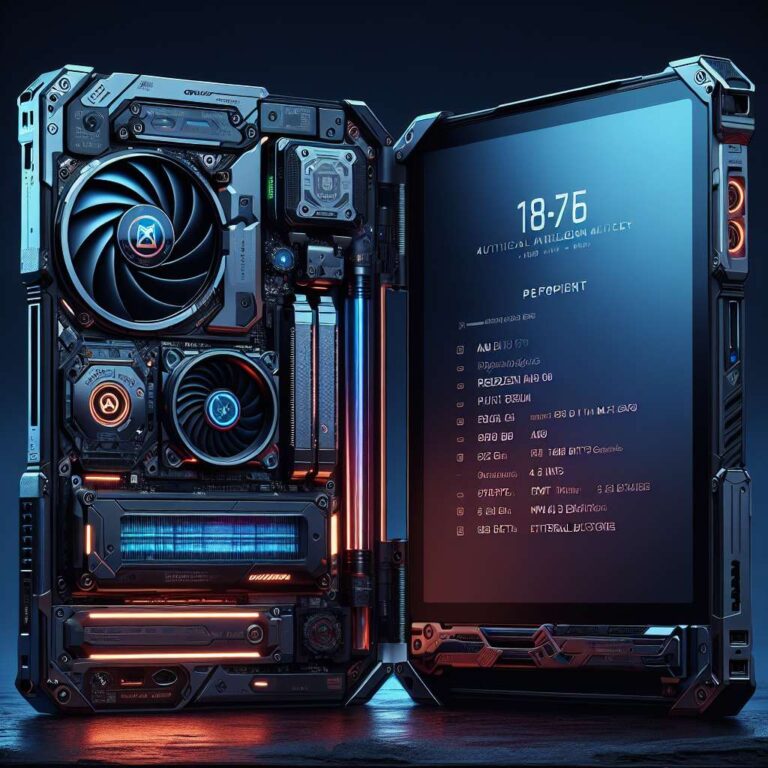
Onexplayer has officially introduced the Onexfly Apex, a Windows gaming handheld built around AMD’s Ryzen Artificial Intelligence Max+ 395 APU and Radeon 8060 graphics. Positioned as a response to recent GPD announcements, the device mirrors some of that rival’s design cues with a detachable battery while going a step further on thermals. Onexplayer claims the Apex is the first Windows handheld capable of allowing the APU to draw as much as 120 W when paired with its liquid cooling solution. The handheld features an 8-inch IPS display running at 120 Hz, with a rated peak brightness of 500 nits and full sRGB coverage.
The liquid cooling system takes the form of a detachable tower that houses the radiator, pump, and reservoir, a concept similar to the XMG Neo 17’s Oasis add-on. In standalone handheld mode without the cooling tower, the company says the APU can sustain an 80 W TDP, with up to 100 W also possible. Power is augmented by an 85 Wh external battery that mounts in a piggyback configuration reminiscent of GPD’s Win 5 detachable pack, enabling higher sustained performance targets than typical handhelds.
Onexplayer showed comparative tests against another handheld using AMD’s Ryzen Z2 Extreme, where the Strix Halo-based Apex outpaced the smaller APU in gaming scenarios. While full, independent benchmarks are not provided, the demonstration underscores the performance ambition of the platform. The Onexfly Apex will be offered with up to 128 GB of LPDDR5x-8000 memory and a 2 TB NVMe SSD, and it also includes an additional M.2 slot for storage expansion, giving users room to scale capacity as needed.
Although clearly designed for gaming, Onexplayer is positioning the Apex as a do-it-all machine, buoyed by the flexibility of its water cooling dock. Between the high-refresh display, aggressive thermal headroom, and robust memory and storage options, the company is pitching a portable system that can push beyond typical handheld limits while remaining adaptable to desk-bound use with the cooling tower attached.