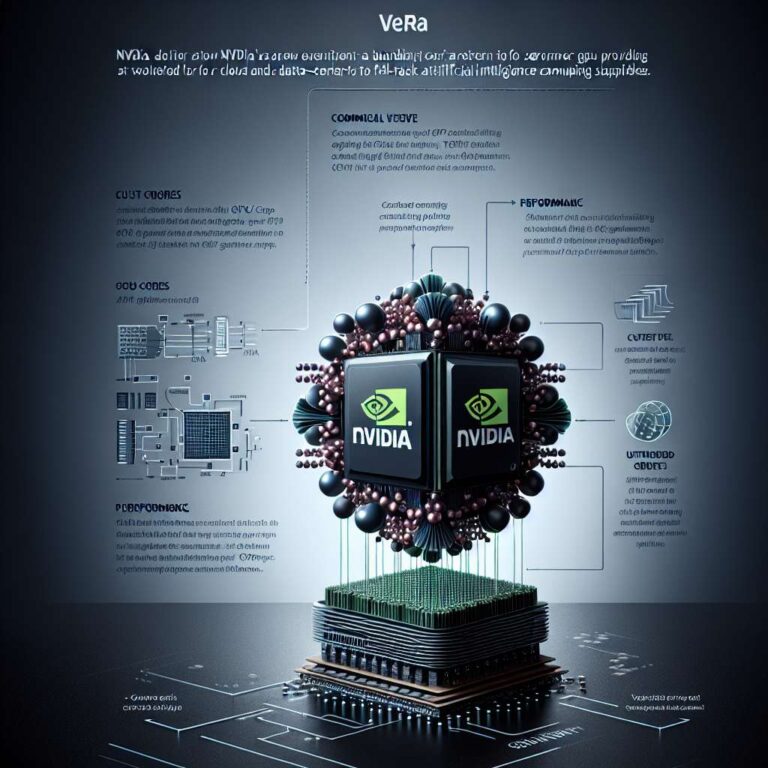
Nvidia is extending its dominance beyond graphics processors into central processors with Vera, a new Arm-based CPU built on custom-designed cores. The company has announced its first customer for Vera and stressed that this is the first time it has supplied a CPU as a standalone product, marking a strategic move into a market long controlled by established server players. The launch underlines Nvidia’s ambition to become a full-stack computing provider rather than simply a graphics specialist.
The first big deployment of Vera comes through a deal with cloud services company CoreWeave, which Bloomberg describes as the effective commercial launch of the chip. In what the article calls a typically circular arrangement within the Artificial Intelligence ecosystem, Nvidia is investing 2 billion in Coreweave, while the cloud company will purchase up to 6 billion in Nvidia hardware, including Vera CPUs. Bloomberg says the Vera CPU will be competing with server chips from Intel and AMD, along with other cloud computing processors such as Amazon’s Graviton, positioning it squarely in the data center rather than the consumer PC arena.
Technical details on Vera are still sparse, but Nvidia has said the chip uses a new custom Arm core design called Olympus. Known specifications include that Vera has 88 cores, is rated at 50 W and offers double the performance of Nvidia’s previous Arm CPU, known as Grace. Grace has 72 cores, so Vera is getting double the performance with a relatively small increase in core count from 72 to 88. 50 W is also a remarkably low power rating for an 88-core CPU. While Grace relies on Arm’s Neoverse V2 cores licensed directly from Arm, Vera’s Olympus cores are Nvidia’s own design, and Nvidia’s roadmap shows Vera with its new Olympus cores as the basis of its CPU products for several years to come.
For PC enthusiasts, the key question is whether Vera and its custom cores will show up in consumer systems. The article says that in the short term, the answer to that seems to be a firm “no,” because Nvidia’s planned Arm CPU for PCs, codenamed N1X, will be based on the GB10 “Superchip” in the DGX Spark mini Artificial Intelligence computer and will not use Vera or Olympus. Instead, N1X will use off-the-shelf Arm-designed Cortex-X925 and Cortex-A725 cores. The piece notes that a rumoured follow-up called Nvidia N2 might be a candidate for custom Arm cores, but frames that as speculative. More broadly, it argues that even if Nvidia delivers extremely powerful Arm hardware for PCs, software support and, in particular, game compatibility will be a major hurdle. The story concludes that there is still substantial work ahead for Arm on the PC, even if a company with Nvidia’s resources is willing to take on the challenge.