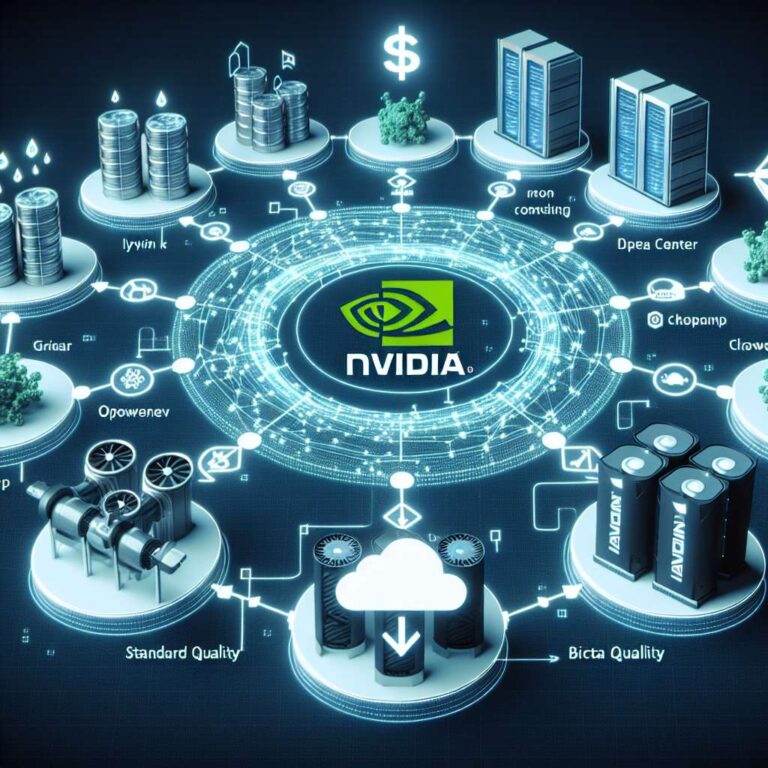
Nvidia’s newly announced investment to help finance OpenAI’s large data center buildout has amplified investor unease about a potential financial bubble around Artificial Intelligence. Beyond the headline, the chipmaker has engaged in a pattern of circular arrangements in which it invests in, lends to, or signs purchase commitments with its own customers. While vendor financing is not unusual, analysts worry these transactions may exaggerate true market demand for Artificial Intelligence compute, leaving Nvidia’s richly valued stock vulnerable to even minor disappointments with broader spillover risks for markets and the economy.
The scope of Nvidia’s backing is hard to quantify, in part because many deals are individually too small to be deemed material yet collectively may be significant. Interlocking relationships complicate the picture: Nvidia has invested in OpenAI and in CoreWeave, a cloud provider to OpenAI that is also a major Nvidia customer. As of June, Nvidia owned about 7% of CoreWeave. Such stakes can lower borrowing costs for data center buildouts, with Seaport Global’s Jay Goldberg likening the practice to a parent co-signing a mortgage. Startups that might otherwise face double-digit interest rates have obtained financing on terms closer to those enjoyed by large incumbents.
In CoreWeave’s case, Nvidia has agreed to backstop unsold cloud capacity and has separate multi-year cloud spending commitments, while CoreWeave has purchased at least 250,000 Nvidia GPUs, mostly H100 Hopper models. Similar dynamics appear with Lambda, where Nvidia agreed to rent thousands of its own Artificial Intelligence chips that Lambda acquired using loans collateralized by the GPUs themselves. Nvidia also holds smaller stakes in Arm, Applied Digital, Nebius Group, and Recursion Pharmaceuticals, and took a minority position in Intel. It has pledged new funding for U.K. Artificial Intelligence startups, including Nscale, and has stepped up global startup investing through NVentures. While precise flows are opaque, research cited in the article suggests Nvidia’s investments can reappear as substantial GPU purchases or lease payments, effectively recycling cash back to the company as revenue.
The structure of the OpenAI deal adds risk: by leasing GPUs instead of selling them, Nvidia spares OpenAI depreciation charges but takes on those costs itself, along with potential inventory risk if Artificial Intelligence demand undershoots expectations. The approach evokes the dotcom era, when telecom equipment makers financed customers and some firms engaged in revenue roundtripping, exacerbating losses when the bubble burst. Analysts are taking note. Goldberg said the arrangements have a whiff of circular financing and reflect bubble-like behavior, while Bernstein’s Stacy Rasgon wrote the action will clearly fuel circular concerns. It is not yet a crisis, but as Artificial Intelligence valuations climb, the margin for error is narrowing.