
NVIDIA’s Omniverse Blueprint Revolutionizes Industrial AI Training

NVIDIA unveils a new blueprint enabling the use of digital twins for training physical Artificial Intelligence in industrial environments.

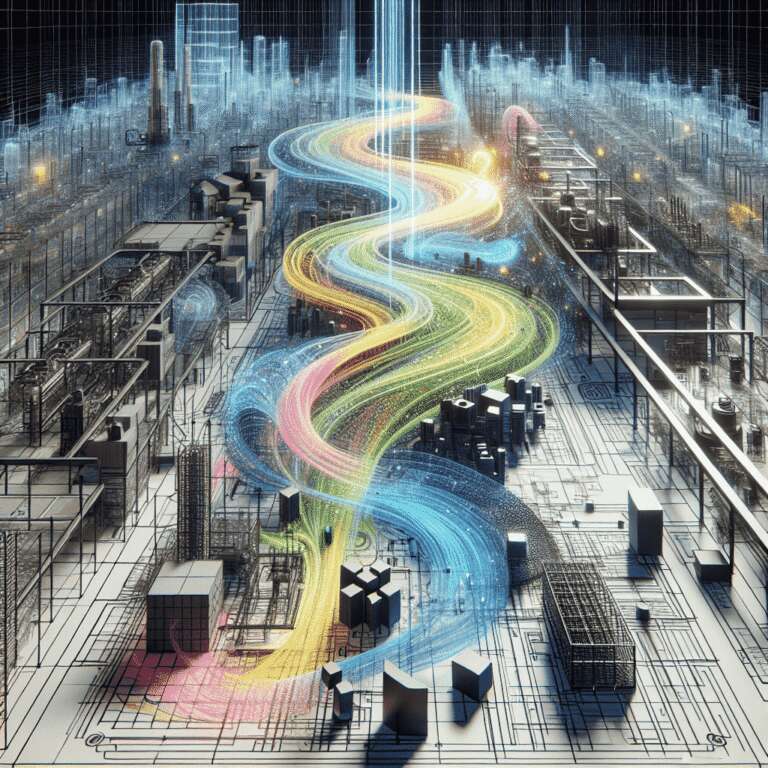
NVIDIA has introduced the Mega Omniverse Blueprint designed to enhance the training and deployment of physical Artificial Intelligence across industrial ecosystems. This new blueprint allows for comprehensive simulations within digital twins—exact virtual replicas of real-world environments—helping to test and validate complex interactions before real-world application.

At the Hannover Messe event, leading industrial figures like Accenture and Schaeffler are showcasing how they employ this blueprint to simulate and optimize operational processes. The technology enables humanoid robots and autonomous mobile robots to navigate and collaborate effectively within intricate industrial settings, enhancing productivity and automation.

NVIDIA’s partnerships with industry giants such as Delta Electronics, Rockwell Automation, and Siemens further establish the blueprint’s wide-ranging applications, integrating with NVIDIA Omniverse and other AI technologies for advanced digital transformations. The Mega blueprint not only accelerates development cycles but also reduces the costs and risks associated with deploying robotics in manufacturing and warehousing sectors.
78

Impact Score

Siemens debuts digital twin composer for industrial metaverse deployments

Siemens has introduced digital twin composer, a software tool that builds industrial metaverse environments at scale by merging comprehensive digital twins with real-time physical data, enabling faster virtual decision making. Early deployments with PepsiCo report higher throughput, shorter design cycles and reduced capital expenditure through physics-accurate simulations and artificial intelligence driven optimization.

Cadence builds chiplet partner ecosystem for physical artificial intelligence and data center designs

Cadence has introduced a Chiplet Spec-to-Packaged Parts ecosystem aimed at simplifying chiplet design for physical artificial intelligence, data center and high performance computing workloads, backed by a roster of intellectual property and foundry partners. The program centers on a physical artificial intelligence chiplet platform and framework that integrates prevalidated components to cut risk and speed commercial deployment.

Patch notes detail split compute and IO tiles in Intel Diamond Rapids Xeon 7

Linux kernel patch notes reveal that Intel’s upcoming Diamond Rapids Xeon 7 server processors separate compute and IO tiles and adopt new performance monitoring and PCIe 6.0 support. The changes point to a more modular architecture and a streamlined product stack focused on 16-channel memory configurations.

Contact Us

Got questions? Use the form to contact us.

Contact Form

Clicking next sends a verification code to your email. After verifying, you can enter your message.