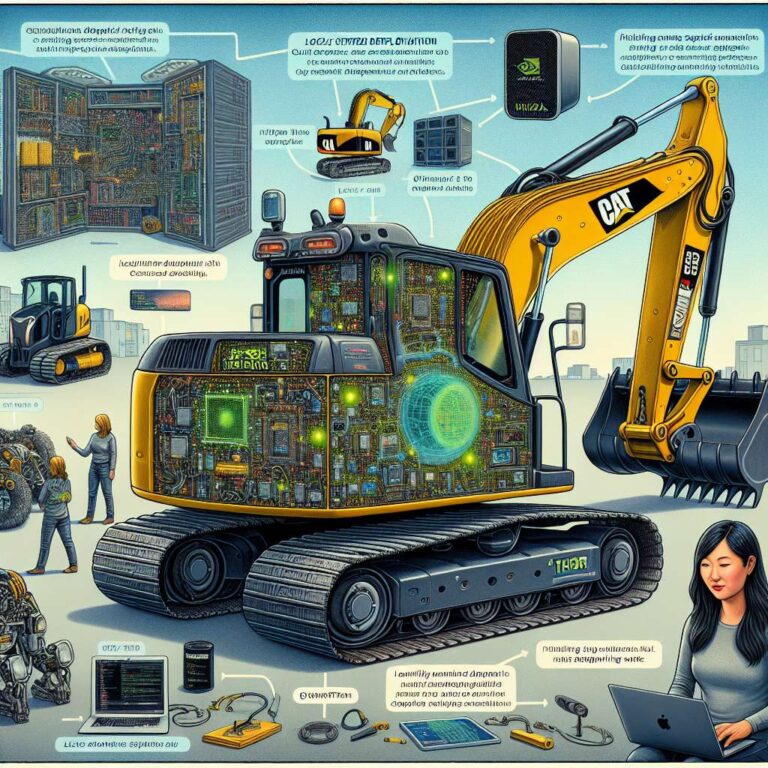
Nvidia’s Jetson platform is positioning open generative models as practical tools for autonomous machines, from construction equipment to household robots. At CES, a Cat 306 CR mini excavator used an in-cab Cat artificial intelligence assistant running on Nvidia Jetson Thor, with Nvidia Nemotron speech models and a locally served Qwen3 4B model handling natural voice interactions and language understanding without a cloud connection. Developers can deploy OpenClaw on Jetson to build private, always-on artificial intelligence assistants at the edge, with Jetson developer kits supporting open models from 2 billion parameters to 30 billion so users can run tasks such as morning briefings, task automation, code review and smart home control in real time.
The shift from cloud data centers to edge devices reflects new priorities around latency, power limits and predictable behavior in physical systems. Jetson integrates compute and memory in a system-on-module to ease hardware design and sourcing amid memory constraints, and more efficient models mean entry-level devices like Jetson Orin Nano 8GB can now run generative artificial intelligence workloads. Across industrial and research applications, physical artificial intelligence systems increasingly execute policies and perception pipelines entirely onboard: Caterpillar is developing an in-cab assistant that combines local speech and language models with machine context for operator guidance and safety; Franka Robotics’ FR3 Duo ran the Nvidia GR00T N1.6 model end-to-end, with perception-to-motion policies executing locally; and Nvidia’s SONIC project trains a humanoid controller on over 100 million frames of motion capture data, then runs the kinematic planner on Jetson Orin at around 12 milliseconds per pass with a 50 Hz policy loop, all onboard.
Research groups and independent developers are using Jetson Thor and Jetson AGX Orin to prototype embodied artificial intelligence agents, from NYU’s YOR household robot using Nvidia Blackwell compute for movement to a dual-arm matcha-making robot that won an Nvidia embodied artificial intelligence hackathon, and a multimodal agent that self-schedules work and runs locally. Jetson now supports a wide spectrum of open models and frameworks, with benchmarks and tutorials available through Jetson AI Lab. On Jetson Thor, Gemma 3 provides a multimodal 128K context window, OpenAI’s gpt-oss-20B runs locally for cost-efficient inference, Mistral 3 family models achieve up to 52 tokens per second for single concurrency and up to 273 tokens per second with concurrency of eight, and Nvidia Cosmos offers 8B and 2B reasoning vision language models for spatial-temporal perception. Additional support spans Nvidia Isaac GR00T N1.6, Nemotron 3 Nano 9B, PI 0.5 and Qwen 3.5 models such as Qwen 3.5-35B-A3B, which reasons at 35 tokens per second. Developers can fine-tune these models into specialized physical artificial intelligence agents using frameworks like Nvidia TRT, Llama.cpp, Ollama, vLLM and SGLang, with further resources available through Hugging Face tutorials and sessions at Nvidia’s GTC 2026.