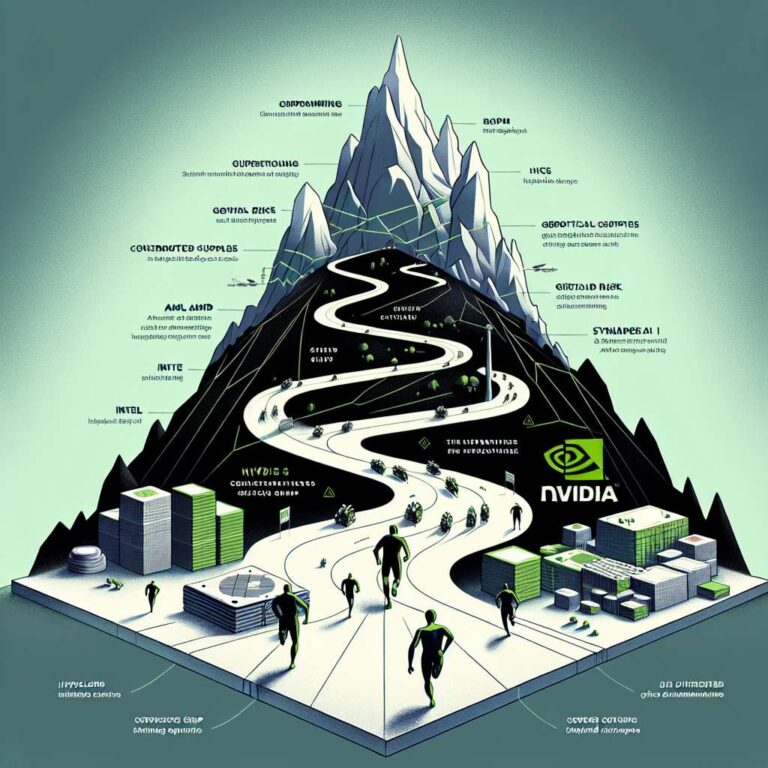
Nvidia sits at the center of the Artificial Intelligence chip boom with a market valuation of three trillion dollars and control between 80 and 92 percent of the Artificial Intelligence accelerator market, supported by quarterly revenue of 57 billion, gross margins of 73.6 percent, and a data center business that accounts for 78 percent of sales. Forecasts put the global market for graphics and Artificial Intelligence accelerators at between 51.8 billion and 101.5 billion for 2025, 136 billion in 2026, and between 295 billion and 592 billion by 2027, underpinned by hyperscalers that had already invested roughly 350 billion by the end of 2025 and plan another 511 billion in 2026. This explosive growth, combined with a structural shortage in data center capacity and 521 announced United States data center projects in 2025 with an average investment of nearly 2 billion per project and occupancy rates at 97 percent, creates ideal conditions for Nvidia yet also makes it a primary target for a growing coalition of challengers.
Nvidia’s most durable advantage is the CUDA ecosystem, which over more than 20 years has amassed more than four million registered developers and over 33 million CUDA Toolkit downloads since 2008, including eight million in 2021, and it is tightly integrated with frameworks such as PyTorch and TensorFlow. The company offers compilers, libraries like TensorRT, cuDNN, and NCCL, and tooling for free, which lowers adoption friction but creates high switching costs, a lock-in reinforced by over 16,000 startups in its Inception program and a reported 30 percent performance gain in its software tools last year. However, AMD is pushing ROCm as an open alternative that supports over two million hugging face models and can port CUDA code via HIP, while Intel is advancing SynapseAI; together they signal a deliberate industry effort to reduce dependence on CUDA even if adoption remains gradual.
Competitive pressure is rising across multiple fronts: AMD’s Instinct MI300 and upcoming MI350 GPUs have captured five to eight percent share, with the MI300X offering 192 gigabytes of memory versus Nvidia’s H100 with 80 gigabytes, and AMD is targeting 14 to 15 billion in Artificial Intelligence GPU revenue with 80 percent annual growth until 2030 and plans an MI450 Helios platform in 2026, backed by a partnership to deliver one gigawatt of MI450 GPUs by mid-2026 with an option to scale to six gigawatts. Google is scaling its Tensor Processing Units, with Morgan Stanley predicting seven million units by 2028 and potentially 13 billion in additional revenue, and TPUs are said to offer a fourfold cost advantage over Nvidia GPUs for inference, which accounts for 70 percent of Artificial Intelligence workloads, with Anthropic planning up to one million TPUs and Google eyeing 20 percent market share if others follow. Broadcom, meanwhile, holds roughly 80 percent of the custom ASIC market with a 73 billion order backlog over 18 months, including approximately 53 billion for Artificial Intelligence XPUs for customers such as Alphabet, Meta, Amazon, Microsoft, OpenAI, and Anthropic, and Citi Research forecasts a 12 billion reduction in Nvidia GPU sales by 2026 linked to that shift.
China is building a largely separate Artificial Intelligence chip stack with Huawei’s Ascend, Baidu’s Kunlun, and Cambricon processors, and Bernstein expects Nvidia’s market share in China to fall from 66 percent in 2024 to eight percent in 2026 while domestic vendors meet 80 percent of demand, driven more by export controls than technology. Baidu’s April 2025 launch of a cluster of 30,000 third-generation Kunlun P800 processors for training foundation models with hundreds of billions of parameters, plus China Mobile contracts worth over 139 million that require CUDA compatibility, illustrate how a parallel software-compatible ecosystem could become closed to Western vendors. Niche players such as Cerebras are exploring radically different designs, including a wafer-scale engine with 900,000 compute cores, 44 gigabytes of on-chip SRAM, four trillion transistors in a CS-3 system that consumes 25 kilowatts, and reported ten to seventy times faster inference versus GPU clusters for some workloads, showing that specialized architectures can outclass general-purpose GPUs in particular scenarios even if they hold less than one percent share.
The most structurally threatening trend is the in-house development of Artificial Intelligence chips by Nvidia’s largest customers: Amazon’s Trainium and Inferentia, which it claims deliver 30 to 40 percent better price-performance than third-party hardware, Microsoft’s Maia series, and Meta’s MTIA family. These hyperscalers account for over 40 percent of Nvidia’s revenue while simultaneously pushing toward a projected 15 to 20 percent market share for their internal solutions by 2028, citing architectural control and reduced dependence on a single vendor that imposes a “Nvidia tax.” Nvidia is countering with an aggressive roadmap: the Blackwell architecture launched in 2024 with 208 billion transistors and ten petaflops of FP4 inference performance, followed by Blackwell Ultra in 2025 and then Rubin in 2026, which is slated to deliver 336 billion transistors, 50 petaflops of FP4 performance, 3.5 times better training efficiency than Blackwell, an 88-core Vera CPU with twice the performance of its predecessor, HBM4, NVLink 6 at 3.6 terabytes per second, a 3-nanometer process, a 1,800 watt TDP, and a cost per token ten times lower than Blackwell, with Rubin Ultra in 2027 combining four GPU chiplets, 100 petaflops of FP4, and one terabyte of HBM4E memory.
Nvidia is deepening strategic ties with key partners, including a announced 100 billion investment in OpenAI to build ten gigawatts of Artificial Intelligence data center capacity by 2026, 2 billion in Elon Musk’s xAI, 5 billion in Intel for NVLink co-development, and the Solstice project with the United States Department of Energy, which will deploy 100,000 Blackwell GPUs and target 2,200 exaflops of Artificial Intelligence performance. Yet this strategy amplifies execution risk: Blackwell has already suffered production issues that hurt margins, gross margins have fallen from a peak of 78 percent in early 2026 to 73.6 percent, and history shows margins can compress from 64 to 56 percent in oversupply cycles. Nvidia’s concentration risk is growing as its top hyperscaler customers represent over 40 percent of revenue, and any pivot toward their own chips could quickly dent its growth trajectory.
Geopolitics and infrastructure constraints add further fragility: over 90 percent of Nvidia’s chips are fabricated by TSMC in Taiwan, leaving it exposed to any Taiwan Strait escalation, while an Arizona plant will not fully offset that dependency, and United States export controls have already driven its China market share from 66 percent in 2024 toward a projected eight percent in 2026. Goldman Sachs estimates that data center power consumption will increase by 165 percent by 2030, requiring 720 billion in network infrastructure investment, with some regions already facing seven-year waits for new connections, a moratorium on new data center hookups in Ireland until 2025, and capacity ceilings in Northern Virginia, which could slow new Artificial Intelligence projects and hence chip demand. A severe high-bandwidth memory shortage, with SK Hynix sold out until 2026 and Samsung booked through 2027 and new capacity not expected until 2027 or 2028, further constrains all accelerator vendors and may push customers to explore alternatives when Nvidia GPUs are unavailable.
Valuation magnifies these operational and strategic risks: Nvidia trades at a forward P/E of 24 to 27 with a price-to-sales ratio of 15.33 that is 52 percent above the industry average, and analyst price targets between 139 and 454, with a 255 consensus implying 36 percent upside, reflect wide uncertainty about future performance. Analysts at Northland Capital Markets warn that the Artificial Intelligence infrastructure investment phase, totaling roughly 350 billion by the end of 2025 and a planned 511 billion in 2026, is in its seventh inning and may slow by mid-2027, while Goldman Sachs expects a cyclical correction within 24 months if returns lag capital spending, which would sharply curtail hyperscaler budgets for new accelerators. Against this backdrop, the article outlines three scenarios for 2026 to 2027, ranging from Nvidia retaining 70-75 percent market share with revenue of 116 billion in 2026 and 191 billion in 2027 and gross margins at 72-74 percent, through an accelerated diversification where share falls to 55 to 65 percent, revenue reaches 100 to 110 billion in 2026, gross margins slip to 68 to 70 percent and the stock drops 20 to 30 percent, to a disruption case where share collapses to 40 to 50 percent, gross margins fall to 60 to 65 percent, growth stalls or turns negative, and the stock loses 40 to 50 percent.
The article argues that a gradual erosion rather than sudden collapse is the most probable path: Nvidia’s share is expected to fall from 80-92 percent to 55-65 percent by the end of 2027, and gross margins from 73.6 percent to 68-70 percent, yet the company remains the leading vendor thanks to its CUDA network, Rubin-led roadmap, and capital strength. However, it concludes that 2026 will be the year multi-vendor Artificial Intelligence infrastructure strategies become a practical necessity, as hyperscalers seek bargaining power, regulators scrutinize concentration, China accelerates its own ecosystem, and rivals such as AMD present asymmetric upside for investors. For portfolio managers, this means Nvidia should not be held uncritically at a premium valuation, and for enterprises, relying on a single chip supplier for mission-critical Artificial Intelligence workloads is increasingly untenable as the “thirty billion dollar duel” over the most valuable digital infrastructure of the 21st century enters its second and far more contested round.