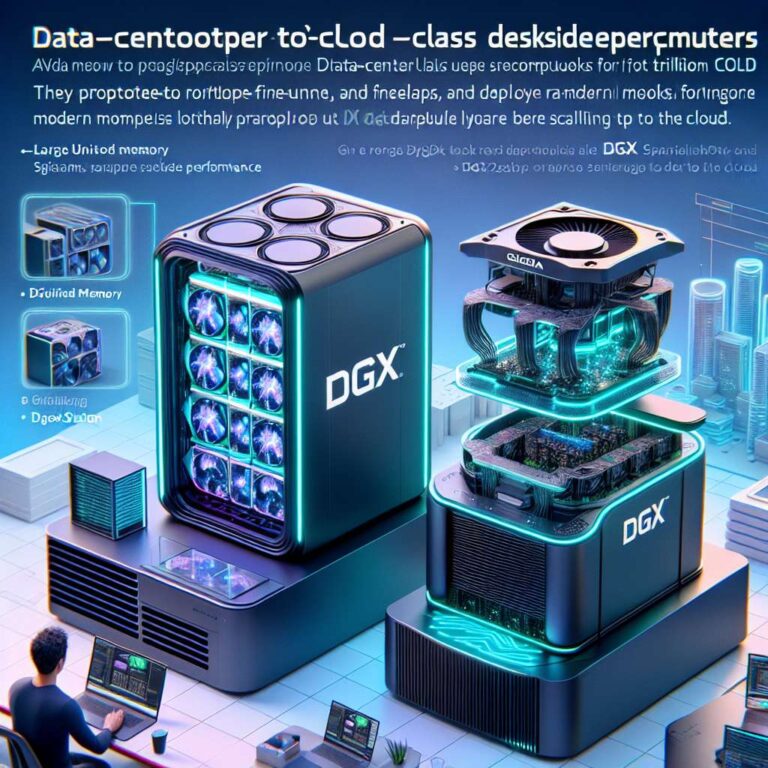
Nvidia used the CES trade show to showcase how its DGX Spark and DGX Station deskside supercomputers enable developers to run the latest open and frontier artificial intelligence models locally, ranging from 100-billion-parameter models on DGX Spark to 1-trillion-parameter models on DGX Station. Both systems are built on the Nvidia Grace Blackwell architecture with large unified memory and petaflop-level artificial intelligence performance, aiming to give teams the flexibility to prototype, fine-tune and deploy models at the desktop and then scale to the cloud as needed. Nvidia positions Spark as a foundation for individual developers and smaller teams, while Station targets enterprises and research labs that need large-scale, frontier models.
DGX Spark is preconfigured with Nvidia artificial intelligence software and Nvidia CUDA-X libraries to offer plug-and-play optimization for developers, researchers and data scientists. Nvidia highlights support for popular open-source frameworks and models, including its Nemotron 3 family, and notes that the Blackwell architecture’s NVFP4 data format allows artificial intelligence models to be compressed by up to 70% to boost performance without losing intelligence. Collaborations with the open-source ecosystem, such as work with llama.cpp, are delivering a 35% performance uplift on average when running state-of-the-art artificial intelligence models on DGX Spark, and llama.cpp also shortens large language model loading times. DGX Station, built around the GB300 Grace Blackwell Ultra superchip with 775GB of coherent memory with FP4 precision, can run models up to 1 trillion parameters, supporting workloads such as Kimi-K2 Thinking, DeepSeek-V3.2, Mistral Large 3, Meta Llama 4 Maverick, Qwen3 and OpenAI gpt-oss-120b.
Early users from projects like vLLM and SGLang describe DGX Station as bringing data-center-class GPU capability into a compact deskside format, enabling testing of GB300-specific features and running very large models like Qwen3-235B locally without reliance on cloud racks. At CES, Nvidia is demonstrating DGX Station handling large language model pretraining at 250,000 tokens per second, large-scale data visualization with Nvidia cuML, and knowledge graph workflows using Text to Knowledge Graph and Llama 3.3 Nemotron Super 49B. DGX Spark and Station are also aimed at creator and robotics workflows, including diffusion and video models such as FLUX.2, FLUX.1, Qwen-Image and LTX-2, with Nvidia claiming DGX Spark delivers 8x acceleration for video generation compared with a top-of-the-line MacBook Pro with M4 Max. Additional showcases include using DGX Spark with Hugging Face’s Reachy Mini robot for embodied agents, OpenRAG-powered retrieval-augmented generation on the edge with IBM, local artificial intelligence coding assistants via Nvidia Nsight, and TRINITY, a self-balancing urban vehicle using DGX Spark as an artificial intelligence brain.
To lower the barrier to adoption, Nvidia is expanding its DGX Spark playbooks with six new entries and four major updates covering topics including Nemotron 3 Nano, robotics training, vision language models, fine-tuning using two DGX Spark systems, genomics and financial analysis, with more playbooks planned for DGX Station and GB300. Nvidia artificial intelligence Enterprise software support is now available for DGX Spark and GB10 systems from partners, with licenses expected to be available at the end of January, bundling libraries, frameworks, microservices and GPU optimization tools for faster engineering and deployment. DGX Spark and partner GB10 systems are available from vendors including Acer, Amazon, Asus, Dell Technologies, Gigabyte, HP Inc., Lenovo, Micro Center, MSI and PNY, while DGX Station is set to be sold by Asus, Boxx, Dell Technologies, Gigabyte, HP Inc., MSI and Supermicro starting in spring 2026.