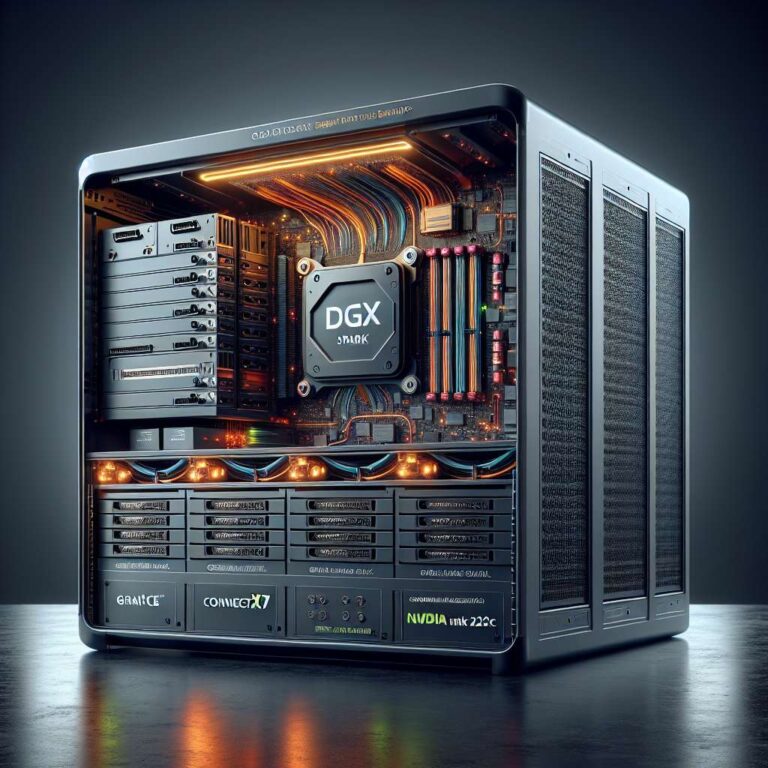
Nvidia announced it is shipping DGX Spark, a desktop system the company calls the world’s smallest Artificial Intelligence supercomputer. Framed as a new class of machine for developers who have outgrown conventional PCs and workstations, DGX Spark packages Nvidia’s full Artificial Intelligence platform into a compact form factor. The company says the system delivers up to 1 petaflop of Artificial Intelligence performance and 128GB of unified CPU‑GPU coherent memory, enabling local inference on models with up to 200 billion parameters and fine‑tuning of models up to 70 billion parameters. CEO Jensen Huang positioned the device as a democratizing step for Artificial Intelligence development, highlighting a hand delivery to Elon Musk at SpaceX as a symbolic nod to the original DGX‑1 era.
DGX Spark is built on the GB10 Grace Blackwell Superchip and pairs it with ConnectX‑7 200 Gb/s networking and NVLink‑C2C interconnect, which Nvidia says offers five times the bandwidth of fifth‑generation PCIe. The integrated design is aimed at accelerating agentic and physical Artificial Intelligence work, bringing lab‑class throughput to the desk. By unifying memory across CPU and GPU and pushing high-bandwidth interconnects into a desktop form factor, the system targets developers who need to run sophisticated models and pipelines locally without relying on cloud resources.
The machine ships with the Nvidia Artificial Intelligence software stack preinstalled, giving immediate access to models, libraries, and Nvidia NIM microservices. Nvidia cites local workflows such as customizing Black Forest Labs’ FLUX.1 models for image generation, creating a vision search and summarization agent with the Nvidia Cosmos Reason vision language model, and building an Artificial Intelligence chatbot using Qwen3 optimized for DGX Spark. Early recipients including Anaconda, Cadence, ComfyUI, Docker, Google, Hugging Face, JetBrains, LM Studio, Meta, Microsoft, Ollama, and Roboflow are testing and optimizing their tools and models for the platform.
Research groups are also engaging with the system. The NYU Global Frontier Lab previewed DGX Spark to speed Artificial Intelligence research, with professor Kyunghyun Cho noting that petascale desktop computing can enable rapid prototyping, including for privacy‑ and security‑sensitive domains such as healthcare. Orders open Wednesday, Oct. 15, on Nvidia.com. Partner systems will be available from Acer, Asus, Dell Technologies, Gigabyte, HP, Lenovo, and MSI, with Micro Center stores in the U.S. and Nvidia channel partners offering broader distribution worldwide.