
NVIDIA designs location verification technology to track GPU smugglers

Reuters reports NVIDIA has developed a software-based location verification tool that identifies where and how its GPUs are deployed to curb GPU smuggling and enforce export restrictions. The company says the service will help data center operators monitor the health and inventory of their Artificial Intelligence GPU fleets.

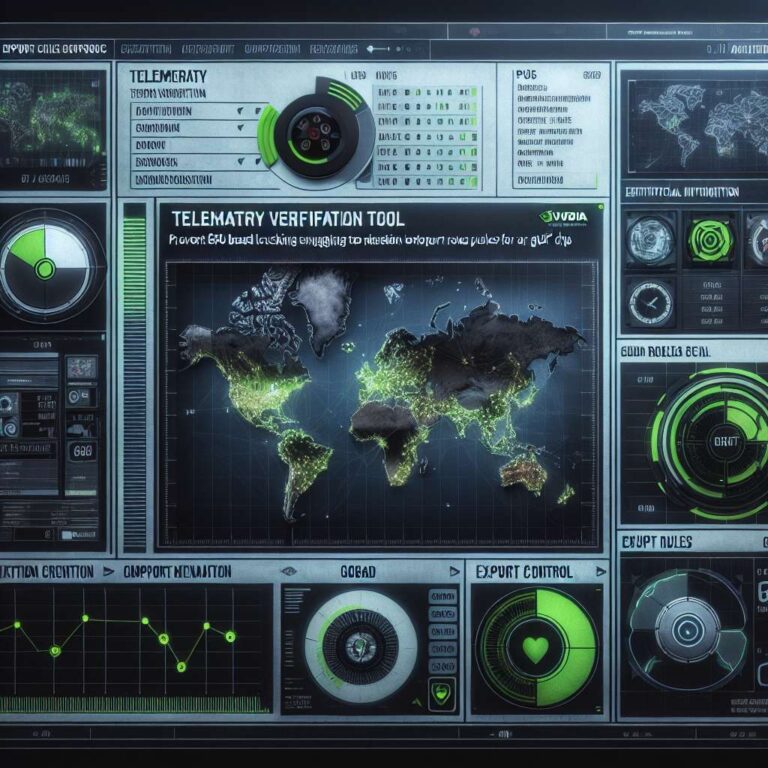
Reuters reports that NVIDIA has developed a software tool intended to verify the locations where its graphics processing units are deployed, a measure the company says could help combat GPU smuggling and enforce U.S. export restrictions. The tool is described as a customer-installed software agent that uses GPU telemetry to monitor fleet health, integrity and inventory. NVIDIA positioned the service as a way for data center operators to track the health and inventory of their entire Artificial Intelligence GPU fleet.

The report frames the development against recent export-control tensions. NVIDIA’s latest ‘Blackwell’ GPUs are banned from sale to certain Chinese entities under U.S. policy, and Reuters says some networks have been able to acquire and export restricted chips via third countries. The story notes that NVIDIA recently received authorization from the Trump administration to sell its H200 ‘Hopper’ GPUs to Chinese customers, a clearance that explicitly excludes the more powerful ‘Blackwell’ generation.

The company told Reuters it is implementing the service to empower data center operators with telemetry-based monitoring. NVIDIA described the offering as a software service that monitors fleet health and inventory and as a customer-installed agent that leverages GPU telemetry to ensure integrity. Reuters frames the capability as a potential tool for tracing device deployments and constraining illicit redistribution of restricted hardware, while also noting the broader regulatory context around GPU exports and enforcement challenges.
65

Impact Score

Indiana launches Artificial Intelligence business portal

Indiana is rolling out IN AI, a statewide portal meant to help employers adopt Artificial Intelligence with practical guidance, workshops and peer support. State leaders and business groups are positioning the effort as a way to raise productivity, wages and job growth while keeping workers at the center.

Goodfire launches model debugging tool for large language models

Goodfire has introduced Silico, a mechanistic interpretability platform designed to let developers inspect and adjust model behavior during development. The company is positioning it as a way to give smaller teams deeper control over open-source models and more trustworthy outputs.

Nvidia launches nemotron 3 nano omni for enterprise agents

Nvidia has introduced Nemotron 3 Nano Omni, a multimodal open model designed to support enterprise agents that reason across vision, speech and language. The launch extends Nvidia’s push beyond hardware into models and services while targeting more efficient agentic workflows.

Intel 18A-P node improves performance and efficiency

Intel plans to present new results for its 18A-P process at the VLSI 2026 Symposium, highlighting gains in performance, power efficiency, and manufacturing predictability. The updated node is positioned as a stronger option for customers seeking 18A density with better operating characteristics.

EA CEO defends broader Artificial Intelligence use in game development

EA CEO Andrew Wilson defended the company’s internal use of Artificial Intelligence after employee claims that the tools were slowing work rather than helping. He framed the technology as an aid for repetitive quality assurance tasks, even as concerns persist over its broader impact on development.

Contact Us

Got questions? Use the form to contact us.

Contact Form

Clicking next sends a verification code to your email. After verifying, you can enter your message.