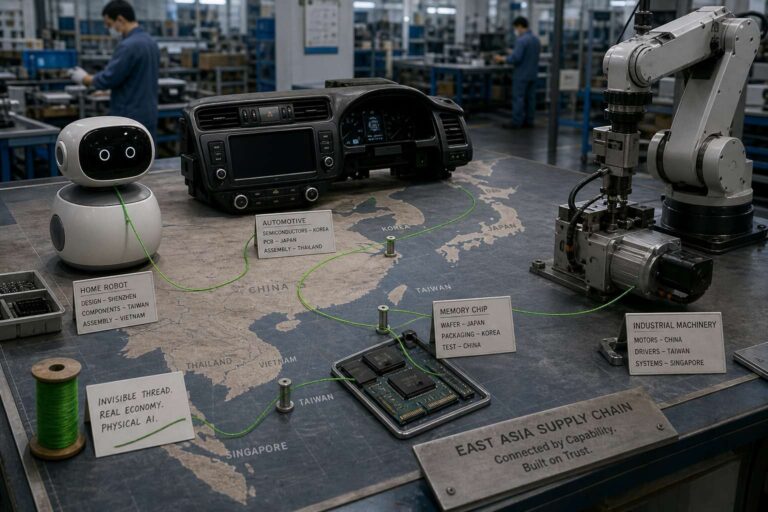
Nvidia’s expansion into physical Artificial Intelligence is widening the circle of Asian companies seen as beneficiaries of its ecosystem. In the past week, South Korea’s LG Electronics, Taiwan’s Nanya Technology, and China’s Huizhou Desay SV Automotive and Pateo Connect Technology Shanghai rallied on news tied to partnerships, supply-chain roles or product collaboration with the US chip designer. The moves underscored how Nvidia-driven demand is shaping stock performance across Asia’s technology supply chain, including companies that are not widely known outside their home markets.
Asian suppliers now account for about 90 per cent of Nvidia’s production costs, up from roughly 65 per cent last year, according to data compiled by Bloomberg. Nvidia has built deeper chip-focused relationships with suppliers such as SK Hynix and Samsung Electronics, but the newest collaborations suggest a broader push beyond semiconductors into physical Artificial Intelligence and robotics. Shares of LG Electronics jumped as much as 15 per cent on Tuesday (Apr 28), their biggest intraday gain since Feb 11, after a domestic media report said the company and Nvidia would discuss integrating its home robot with Nvidia’s platform. In Taiwan, Nanya Technology’s shares surged 10 per cent after a local news report on the chipmaker’s collaboration with Nvidia.
In China, Huizhou Desay rallied after unveiling a new mass-production intelligent driving solution with Nvidia, while Pateo Connect Technology’s shares soared after entering a series of collaborations with the company. LG Electronics confirmed it recently met with Nvidia and said both sides are exploring strategic collaboration in physical Artificial Intelligence, including the robotics ecosystem. Samsung Electronics declined to comment, and Nanya said it does not comment on customer-related information.
Nvidia’s push into physical Artificial Intelligence, spanning robotics, autonomous systems and Artificial Intelligence-enabled manufacturing, is broadening demand across industries and reinforcing Asia’s role in real-world deployment. Jensen Huang has described physical Artificial Intelligence as the next wave after generative Artificial Intelligence. Analysts said the shift could help technology-heavy north Asian markets continue to outperform as more suppliers join the buildout.
The latest capital expenditure guidance from US tech giants shows Artificial Intelligence spending is accelerating, with Amazon.com, Microsoft and Alphabet each committing roughly US? billion to US? billion for this year and Meta Platforms raising its outlays to as much as US? billion. Nvidia accounts for about half of Microsoft’s capital expenditure and roughly a quarter of Amazon’s, with a smaller but still leading share at Meta and Alphabet. Hon Hai remains a consistent secondary beneficiary, while SK Hynix takes a mid-single-digit share across companies. Supplier earnings have reflected that surge in demand, with Samsung’s semiconductor arm posting a 48-fold jump in profit and SK Hynix reporting a five-fold increase in quarterly earnings.