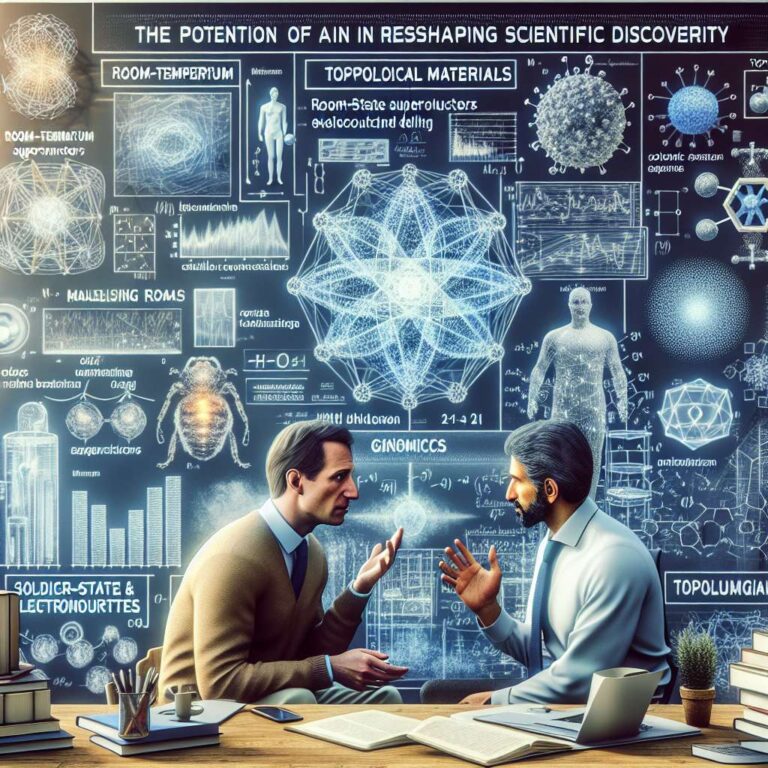
Noah Smith opens with a discussion of how Artificial Intelligence could reshape materials science, and Claude responds with a broad list of candidate breakthroughs. The exchange highlights room-temperature superconductors, solid-state electrolytes, direct air capture sorbents, green hydrogen and ammonia catalysts, ultra-high-performance alloys, self-healing materials, next-generation photovoltaics, designer proteins, topological materials, fusion-resistant materials, thermoelectrics, biodegradable plastics, neuromorphic substrates, metamaterials, better LEDs, and carbon-negative cement. Across those categories, the shared theme is that Artificial Intelligence is most useful when the search space is vast, the tradeoffs are multi-dimensional, and human intuition alone is too limited to explore the possibilities efficiently.
Claude argues that timelines depend not just on discovery but on synthesis, scale-up, testing, and regulation. Several examples are framed as already having proof of concept while remaining far from mass deployment because industry qualification is slow and practical engineering is hard. On topological materials, Claude gives a detailed explanation of how these systems differ from conventional materials by their global electronic structure rather than only local properties. The conversation describes topological insulators and Weyl semimetals as promising for spintronics, thermoelectrics, and possibly quantum computing, while stressing that the main challenge is identifying materials that combine exotic physics with useful real-world properties such as stability, clean surfaces, and compatibility with manufacturing. Artificial Intelligence is presented as especially useful in mapping the complex relationship between chemistry, crystal structure, and topological behavior.
The discussion then widens to ask which sciences may accelerate most under powerful Artificial Intelligence. Claude points to drug discovery, molecular biology, weather and climate modeling, genomics, synthetic biology, mathematics, astronomy, and chip design as fields where the combination of large search spaces, useful simulations, and measurable feedback loops creates strong conditions for progress. By contrast, Claude is more skeptical about rapid breakthroughs in areas where data is sparse, experiments are slow or impossible, or the core obstacle is conceptual framing rather than search. Fundamental physics, consciousness research, macroeconomics, ecology, and the deepest parts of mathematics are described as domains where even very capable systems may struggle because there is too little signal, too few decisive experiments, or no agreed target to optimize toward.
Smith pushes Claude on whether Artificial Intelligence may become good at invention much faster than expected. Claude concedes substantial uncertainty and gives “maybe 25-35% probability that Artificial Intelligence systems produce something that clearly qualifies as a novel conceptual framework in some scientific field within 5 years.” Even so, both converge on a more specific argument about physics: it may not just be difficult to discover new fundamental laws, but possible that much of the simple, technologically useful structure has already been found. Smith suggests future discoveries in high-energy physics may be inaccessible at Earthly scales and therefore limited in practical value, while the more consequential frontier may lie in complex systems where known laws still leave enormous unexplored structure.
That leads to Smith’s idea that human science has historically excelled at finding patterns simple enough to compress into formulas and teach to other people, while Artificial Intelligence may be able to exploit stable but highly complex regularities that humans cannot intuit or communicate directly. He calls these patterns “Cloud Laws.” The conversation uses large language models themselves as a central example: systems that learned powerful, generalizable structure in language without reducing that structure to simple human-readable rules. From there, the exchange turns optimistic. If complex regularities are most important in biology, psychology, neuroscience, and society, then the biggest payoff from Artificial Intelligence may not be more powerful machines alone, but a deeper ability to understand suffering, cognition, and human experience. Smith closes by saying he remains worried about the road ahead, but optimistic about the long-term destiny of humans and Artificial Intelligence if that future can be reached.
An update adds a counterpoint from a materials scientist working on autonomous labs, who argues that many of Claude’s timelines are unrealistic and that verification remains the central bottleneck in real-world science. Experimental testing in materials systems is slow, costly, and does not offer the near-instant feedback available in software. Smith broadly agrees that Artificial Intelligence is not a magic bullet and says its current strengths are more obvious in theoretical disciplines, where progress comes from tracing logical implications and checking outputs, than in laboratory fields that still depend on physical experimentation. He notes that some researchers are now pursuing world models that aim to learn causal structure from richer data, while leaving open how far that approach will ultimately go.