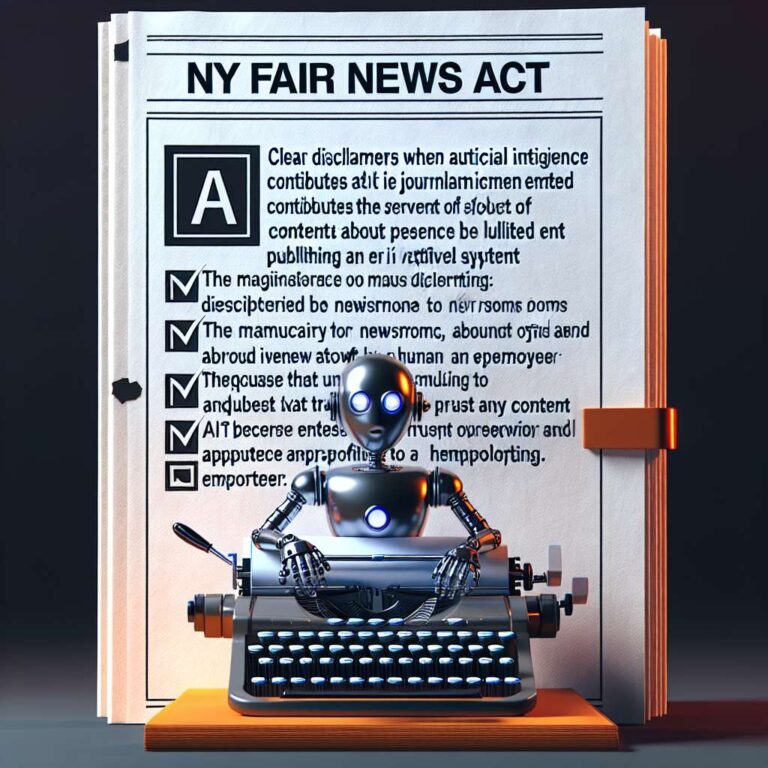
New York senator Patricia Fahy and assemblywoman Nily Rozic have introduced the New York Fundamental Artificial Intelligence Requirements in News Act, known as the NY FAIR News Act, to establish protections for journalists, media professionals and the public as artificial intelligence becomes more prevalent in news production. The legislation seeks to ensure the integrity of news content and the security of newsroom workflows by setting baseline requirements for how artificial intelligence can be deployed in reporting, editing and distribution. Supporters frame the bill as a response to growing concerns that generative systems could undermine trust in journalism and weaken labor protections for media workers.
The bill, S.8451/A.8962-A, requires clear disclaimers when artificial intelligence is used in any published news content and mandates full disclosure to newsroom staff about how and when artificial intelligence is used in the workplace. It further stipulates that all news stories, articles, audio, visuals or images created by artificial intelligence must first be reviewed by a human employee with editorial control before publication. The proposal also establishes safeguards intended to prevent journalist sources and confidential materials from being accessed by an artificial intelligence system, placing particular emphasis on the protection of sensitive information that underpins investigative reporting.
Backers of the NY FAIR News Act include a broad coalition of unions such as the New York State AFL-CIO, Writers Guild of America East, Screen Actors Guild-American Federation of Television and Radio Artists, Directors Guild of America and the NewsGuild of New York. Senator Fahy cited polling that shows that more than 76% of Americans are concerned about artificial intelligence stealing or reproducing journalism and local news stories, arguing that the measure offers common sense guidelines to protect public trust in news. Union leaders describe artificial intelligence as a demonstrable threat to the integrity of news and democratic processes, but say the bill would impose necessary transparency, consent and oversight requirements so the technology remains a tool that supports, rather than replaces or exploits, human journalists.