
New Method Extracts Simple Rules from Complex Neural Networks

A novel approach unveils the underlying logic of neural networks, making complex predictions more understandable.

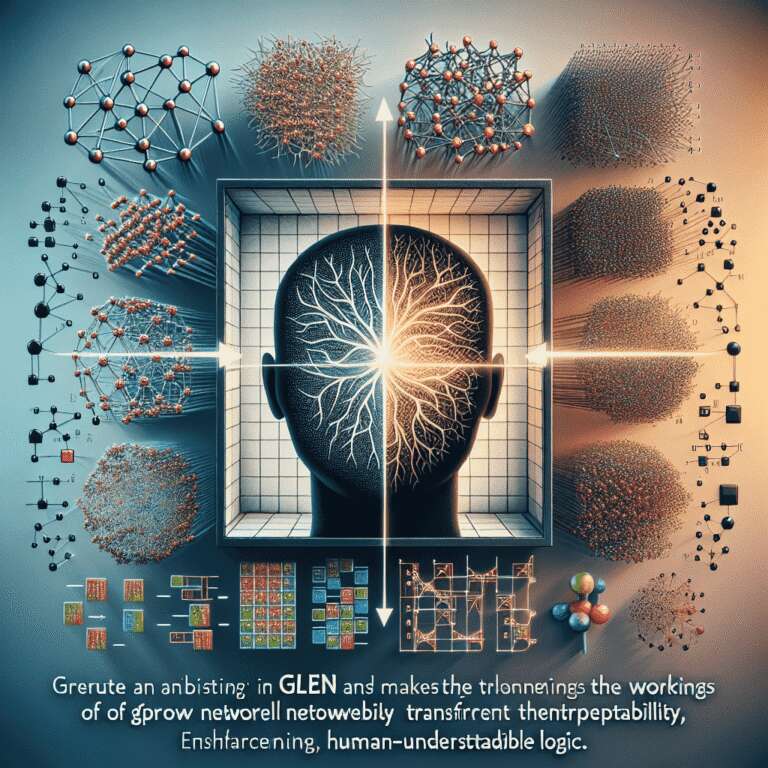
A groundbreaking study has introduced a method called GLEN that extracts simple, interpretable rules from complex Neural Networks, particularly Graph Neural Networks (GNNs). This method focuses on maintaining the predictive power of GNNs while significantly enhancing their transparency and interpretability.

The GLEN approach employs a two-stage process involving pruning and rule extraction to decode the sophisticated logic of GNNs, which are used extensively for tasks involving connected data, such as social networks and molecular structures. By leveraging this method, researchers achieved up to 95.7% fidelity to the original GNN predictions without losing performance, thus bridging the gap between high-performance and explanation in machine learning models.

One of the key advantages of this technique is that it offers human-readable logic rules that align with domain knowledge present in real-world datasets. This has profound implications for industries relying on deep learning models to provide explanations for their predictions, enhancing trust and utility in these systems.
77

Impact Score

Google unveils new Artificial Intelligence models and personal agents

Google used its I/O developer conference to introduce updated Gemini models and personal Artificial Intelligence agents aimed at competing more aggressively with OpenAI and Anthropic. The push centers on stronger models, wider product integration, and a broader enterprise and developer pitch.

Policymakers weigh pause on Artificial Intelligence data center construction

Federal, state, and local officials are moving to slow or condition large data center development as concerns grow over electricity costs, grid strain, environmental effects, and labor standards. Proposed moratoriums and tax incentive changes are creating new uncertainty for developers, hyperscalers, and financiers.

European Union delays key Artificial Intelligence Act obligations

European Union lawmakers have agreed to revise the Artificial Intelligence Act, delaying major high-risk compliance obligations and easing some overlapping requirements. The changes give businesses more time to prepare while preserving the law’s core framework for high-risk systems and transparency rules.

Contact Us

Got questions? Use the form to contact us.

Contact Form

Clicking next sends a verification code to your email. After verifying, you can enter your message.